
You already live and work here, so why does the paperwork feel harder? The 189 visa requirements look simple on paper, yet onshore applicants face extra questions about timing and status. Your expression of interest (EOI) can sit in SkillSelect while your current visa runs down. Your Australian payslips must line up with your skills assessment. One gap can cost you points or lawful status. This guide explains the onshore side of the skilled independent visa: when to lodge an EOI, what happens after you apply, how to prove local work, and how to stay lawful while you wait.
Key Takeaways
- An EOI is not a visa application. It gives you no bridging visa, so your current visa must keep you lawful until you are invited and lodge.
- Once you lodge your Australia visa 189 application onshore, you usually receive a Bridging visa A, which comes into effect only when your current substantive visa ends.
- Australian work experience counts only when you prove it properly and you held a valid visa and met its conditions, so treat any 189 visa points calculator result as a starting point.
The 189 Visa Requirements That Apply When You Are Already Here
The core rules are the same for everyone, but onshore applicants face extra checks on visa status. As of October 2026, Home Affairs lists these criteria on its Skilled Independent visa page. To be invited, you must:
- have an occupation on the relevant skilled occupation list
- hold a suitable skills assessment obtained within the 3 years before your invitation
- be under 45 when you are invited
- have at least competent English at the time of invitation
- score at least 65 points in your EOI
Your invitation also states a points score. You must prove that score when you apply, and it may be higher than 65. Before you rely on any 189 visa points calculator, read how the points test is scored for each claim.
Meeting the 189 visa requirements on paper is only half the job. When you lodge in Australia, you must hold a substantive visa or a Bridging visa A, B or C. Otherwise Home Affairs will not process the application. If you hold, or last held, a 491 or 494 visa, you must have held it for at least 3 years when you apply. As of October 2026, the base application charge for the main applicant is AUD 6,135. Family members add further charges, so check the current figure in the Visa Pricing Estimator before you lodge.
EOI Timing Versus Your Current Visa Expiry
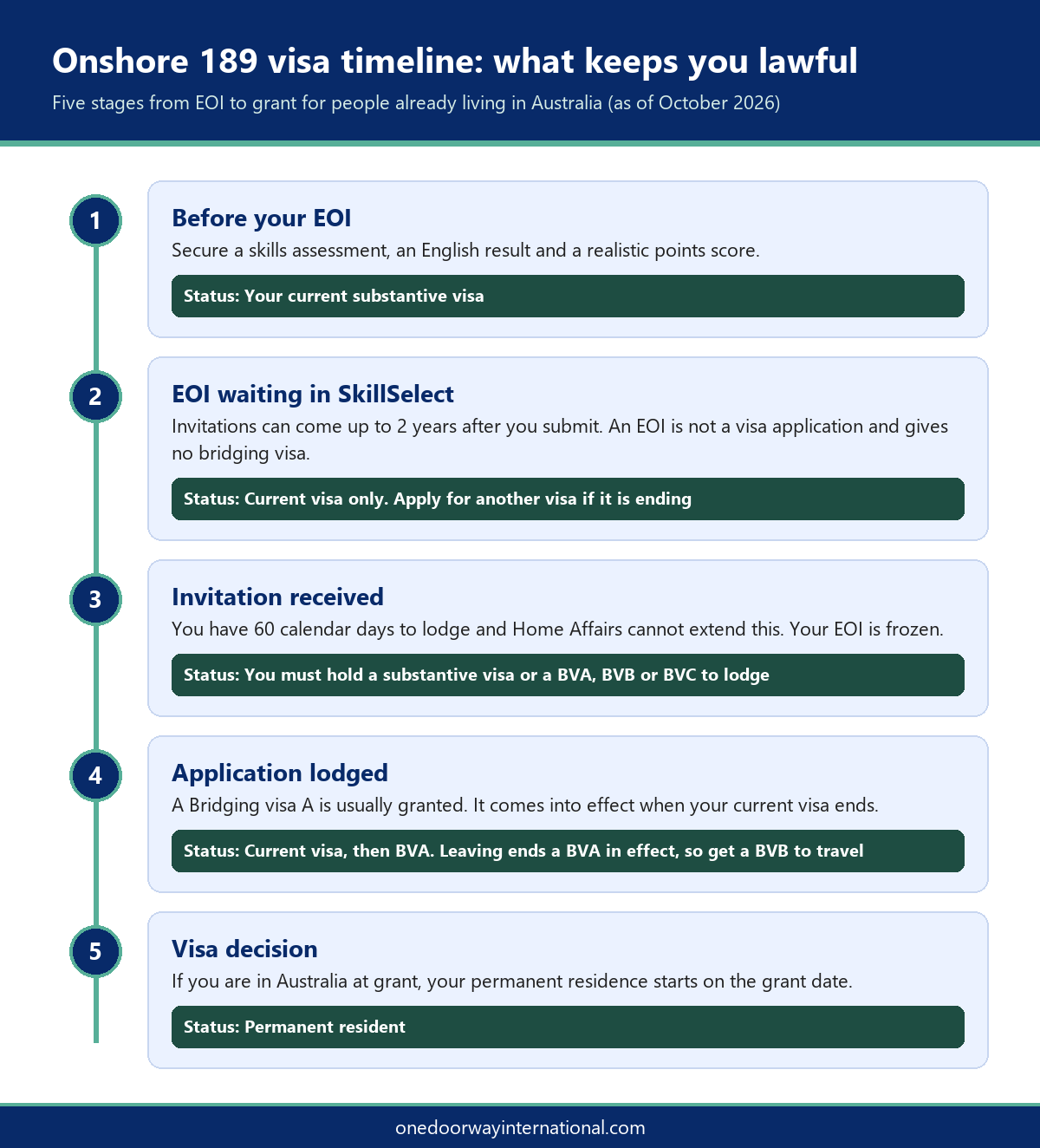
Timing is one of the 189 visa requirements that onshore applicants most often underestimate. Home Affairs says you could receive an invitation up to 2 years after you submit an EOI. Your 485, student visa or Skills in Demand visa (subclass 482) may end long before then.
Home Affairs is clear that an EOI is not a visa application. Submitting one does not give you a bridging visa. If your visa is about to expire, you must apply for another visa to stay lawful. You cannot wait on the EOI alone.
Map three dates side by side:
- the date your current visa ends, which you can check in VEVO
- the date your skills assessment turns 3 years old
- the date you turn 45, because you cannot be invited after that
When an invitation arrives, you have 60 calendar days to lodge, and Home Affairs cannot extend this. Your EOI is frozen during that period, so every claim must already be provable. Update your EOI whenever your points change, for example after a new PTE or IELTS result or a work anniversary. Update it too if you stop working at least 20 hours a week in your nominated occupation.
What Happens to Your Status After You Lodge
Once you lodge a valid application in Australia, Home Affairs generally grants you a Bridging visa A (BVA). The Bridging visa A rules explain that it waits in the background while your current substantive visa is still in effect. It comes into effect only when that visa ends. Until then, you keep following the conditions of your current visa.
Three practical points matter after you lodge your Australia visa 189 application:
- Work rights on a BVA depend on its conditions. Check them in VEVO once it comes into effect.
- A BVA that is in effect ceases when you leave Australia. To travel and return, get a Bridging visa B before you go.
- Never ask Home Affairs to cancel your current visa. If it is cancelled, your BVA ceases and you become unlawful.
There is useful news on timing. As of October 2026, Home Affairs lists applications where the primary applicant was in Australia at lodgement among its skilled processing priorities. Processing still varies case by case, so treat any published timeframe as a guide only. Attach every document when you lodge and answer any request for information quickly. Home Affairs may decide without asking you for more.
Evidencing Your Australian Work Experience
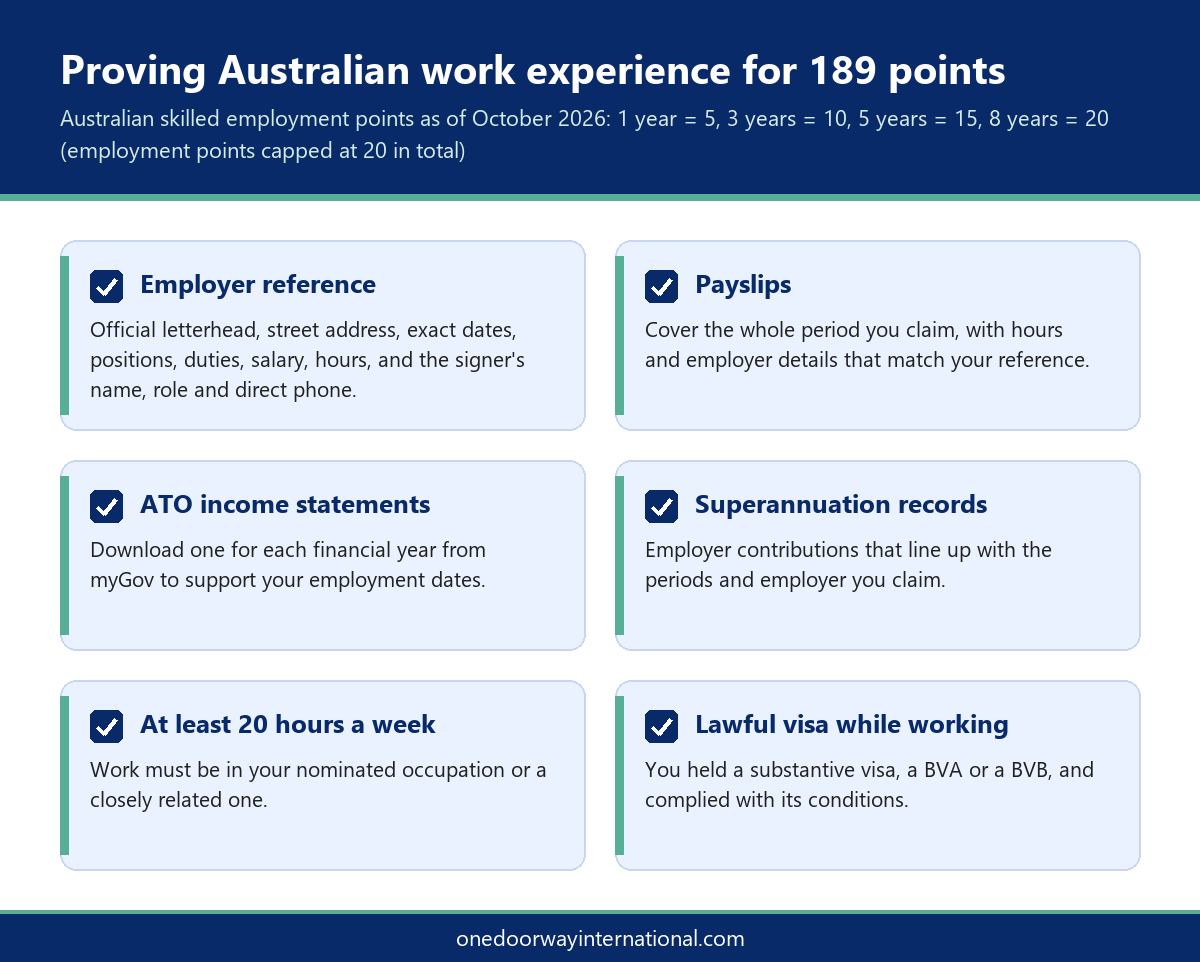
Australian skilled employment can add real points to a skilled independent visa claim. As of October 2026, the points table gives 5 points for at least 1 year, 10 points for 3 years, 15 points for 5 years and 20 points for 8 years. The work must fall within the 10 years before your invitation. Overseas and Australian employment points combined are capped at 20.
Two conditions catch many onshore applicants. First, employed means at least 20 hours a week in your nominated occupation or a closely related one. Second, for any Australian employment you must have held a substantive visa, a BVA or a BVB, and complied with its conditions. Under the 189 visa requirements, work done in breach of a visa condition may not earn points.
Home Affairs accepts references, contracts, payslips, tax statements, payment summaries and superannuation records. Build a file that tells one consistent story:
- employer references on letterhead with the street address, exact dates, positions held, full time or part time status, duties, salary, and the signer's name, position and direct phone number
- payslips that cover the whole period you claim
- your ATO income statements from myGov for each financial year
- superannuation statements showing employer contributions
Your assessing authority may count only the employment it treats as skilled. Read your outcome letter closely, and confirm which authority assesses your occupation if you are unsure.
Keeping a Lawful Visa While You Wait for an Invitation
Treat an invitation as uncertain and plan your next visa now. A 485 holder might look at employer sponsorship. A student might consider further study. Some people also lodge EOIs for state nomination, and comparing the 189, 190 and 491 helps you weigh those options.
Before you choose, check VEVO for any condition that limits further applications in Australia. Some visas restrict which visas you can apply for onshore. If yours has a condition like this, get advice before you plan any onshore application. Apply for your next visa before the current one ends, so a bridging visa can cover any gap.
Keep your evidence current while you wait. Save payslips each month, download your income statement after each financial year, and ask for an updated reference when your duties or hours change. If an invitation comes, most of your file will then be ready inside the 60 day window.
Our skilled migration services cover EOIs, visa planning and lodgement. A registered migration agent can review your dates and evidence before an invitation arrives, not after.
Conclusion
Applying from inside Australia has real advantages, but only when your timing and evidence line up. The 189 visa requirements reward people who plan early. Keep a substantive visa until you lodge. Understand how your BVA works, and never travel on one without a BVB. Build employment evidence that matches your skills assessment and your EOI claims. If your visa expiry, skills assessment date or 45th birthday is getting close, act now. Book a consultation with our Narre Warren office and our MARA registered team will check your dates and documents before you lodge.