
If you already live in Australia, professional year points are some of the most practical marks you can add to a skilled visa score. The same goes for NAATI CCL points, Australian study requirement points and regional study points. Most of these reward study, training or work you complete here, often while you hold a student, graduate or sponsored work visa. This guide explains each onshore factor, the points it carries as of October 2026, who qualifies and how to time each claim against your invitation date.
Key Takeaways
- Professional year points, NAATI CCL points and Australian study requirement points are each worth 5 on the Home Affairs points table as of October 2026.
- Regional study points add another 5, and a research Masters or Doctorate in an eligible STEM field adds 10 for specialist education.
- Australian skilled work adds 5 to 20 points, but overseas and Australian work together are capped at 20.
Which PR Points Can You Earn Inside Australia?
The points test for the 189, 190 and 491 visas includes a group of factors tied to time in Australia. Offshore applicants still claim age, English and overseas work. The onshore factors reward study, training and work you complete here.
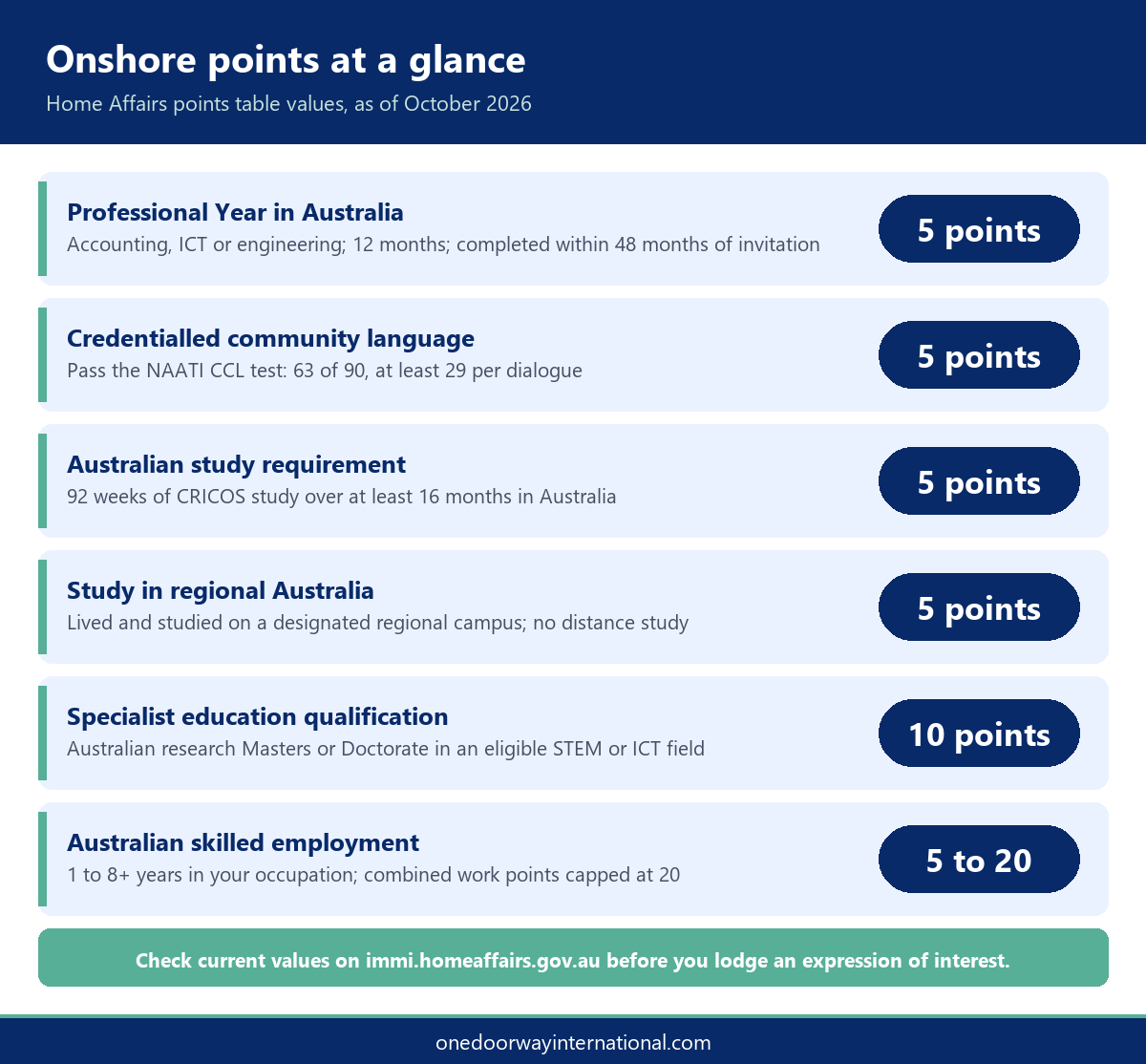
As of October 2026, the Home Affairs points table for the subclass 189 visa lists these values:
- Professional Year in Australia: 5 points
- Credentialled community language: 5 points
- Australian study requirement: 5 points
- Study in regional Australia: 5 points
- Specialist education qualification: 10 points
- Australian skilled employment: 5 to 20 points
Stacked together, these factors can lift a borderline score into a far stronger range. They do not replace the core criteria, though. You still need a suitable skills assessment, at least competent English and an eligible occupation. For every factor and a worked score, use our step by step points test guide. It covers the age, English and partner points that sit outside this article.
Each onshore claim needs documents that prove it at the time of invitation. Professional year points, for example, rely on a Record of Completion from the provider. Keep transcripts, CRICOS course codes, payslips and your NAATI result in one folder from day one.
Professional Year Points: Who Qualifies and When They Count
Professional year points reward a structured career program that combines workplace training with an internship in an Australian business. As of October 2026, completing a Professional Year earns 5 points. The program must be in accounting, ICT or computing, or engineering.
Home Affairs sets these conditions before it awards professional year points:
- The program relates to your nominated occupation or a closely related one.
- It ran for at least 12 months.
- You completed it in Australia within the 48 months before your invitation.
- An approved body delivered it: the Australian Computer Society, CPA Australia, Chartered Accountants Australia and New Zealand, the Institute of Public Accountants or Engineers Australia.
Professional year points suit accounting, ICT and engineering graduates whose scores sit just below recent invitation rounds. If your occupation falls outside those three fields, the program will not earn points, however useful the experience is.
The date on your official Record of Completion is the date that counts. You can start earlier, as long as you finish inside the 48 month window. Many graduates enrol while they hold a 485 Temporary Graduate visa, since the program runs for a full year. Fees vary by provider, so confirm the current price before you commit. Professional year points stop counting once your completion date falls outside the window, so plan your invitation timing with care.
NAATI CCL Points: A Language Credential Many Residents Add
NAATI CCL points come from the Credentialed Community Language test run by NAATI. As of October 2026, the points table awards 5 points for a credentialled community language. The test checks whether you can interpret everyday conversations between English and one other language.
Key facts from the NAATI CCL test page, checked in October 2026:
- The test fee is $814 AUD.
- It is delivered online only, at times set in Australian Eastern Time.
- You interpret two recorded dialogues worth 45 marks each.
- A pass needs 63 out of 90, with at least 29 marks in each dialogue.
- Credentials issued from 9 August 2022 are valid for five years.
Because the test runs online, offshore candidates can sit it too. Still, many people in Melbourne add NAATI CCL points while they wait on a skills assessment or an English retest. It suits applicants who use their community language at home every day. If English is your bigger gap, read our guide to English test scores and the points they earn. Passing the CCL does not make you a certified interpreter. NAATI also advises confirming that the test is accepted for points before you book. Many applicants combine NAATI CCL points with professional year points to close a 10 point gap.
Australian Study Requirement Points, Regional Study Points and Specialist Education
Australian study requirement points go to graduates who completed substantial study here. As of October 2026, meeting the requirement earns 5 points. Home Affairs sets these rules:
- At least 2 academic years of study, which equals 92 weeks of CRICOS registered study.
- Study completed in Australia over no less than 16 calendar months.
- A bachelor degree or higher, diploma, advanced diploma or trade qualification taught in English.
- A visa that allowed you to study for the whole period.
English courses and enabling programs do not count. CRICOS sets the standard course length, so taking longer does not add weeks. Failed subjects do not count either.
Regional study points add a further 5 points as of October 2026. Your qualification must already earn Australian study requirement points. You must also have lived in, and studied at a campus in, a designated regional area. Distance study does not qualify. Most areas outside Sydney, Melbourne and Brisbane are designated regional, so a Geelong campus can count while a Melbourne city campus cannot. Check the current postcode list before you choose a campus. Keep proof of your local address for the whole course too, because regional study points depend on where you lived as well as where you studied.
Specialist education earns 10 points. It applies to a Masters by research or a Doctorate from an Australian institution, with at least 2 academic years in a listed science, technology, engineering, mathematics or ICT field. Coursework Masters degrees do not qualify for this factor.
Australian Work Experience and Your Points Timeline
Australian skilled employment can be the largest onshore factor. As of October 2026, the table awards:
- At least 1 but less than 3 years: 5 points
- At least 3 but less than 5 years: 10 points
- At least 5 but less than 8 years: 15 points
- At least 8 years: 20 points
The work must be in your nominated or a closely related occupation, for at least 20 hours a week, within the 10 years before invitation. You must have held a substantive visa or a Bridging A or B visa and complied with its conditions. Overseas and Australian work points together are capped at 20. If you are weighing a Professional Year against another year of work, compare the gain. Professional year points give 5, and moving from 1 to 3 years of Australian work adds another 5.
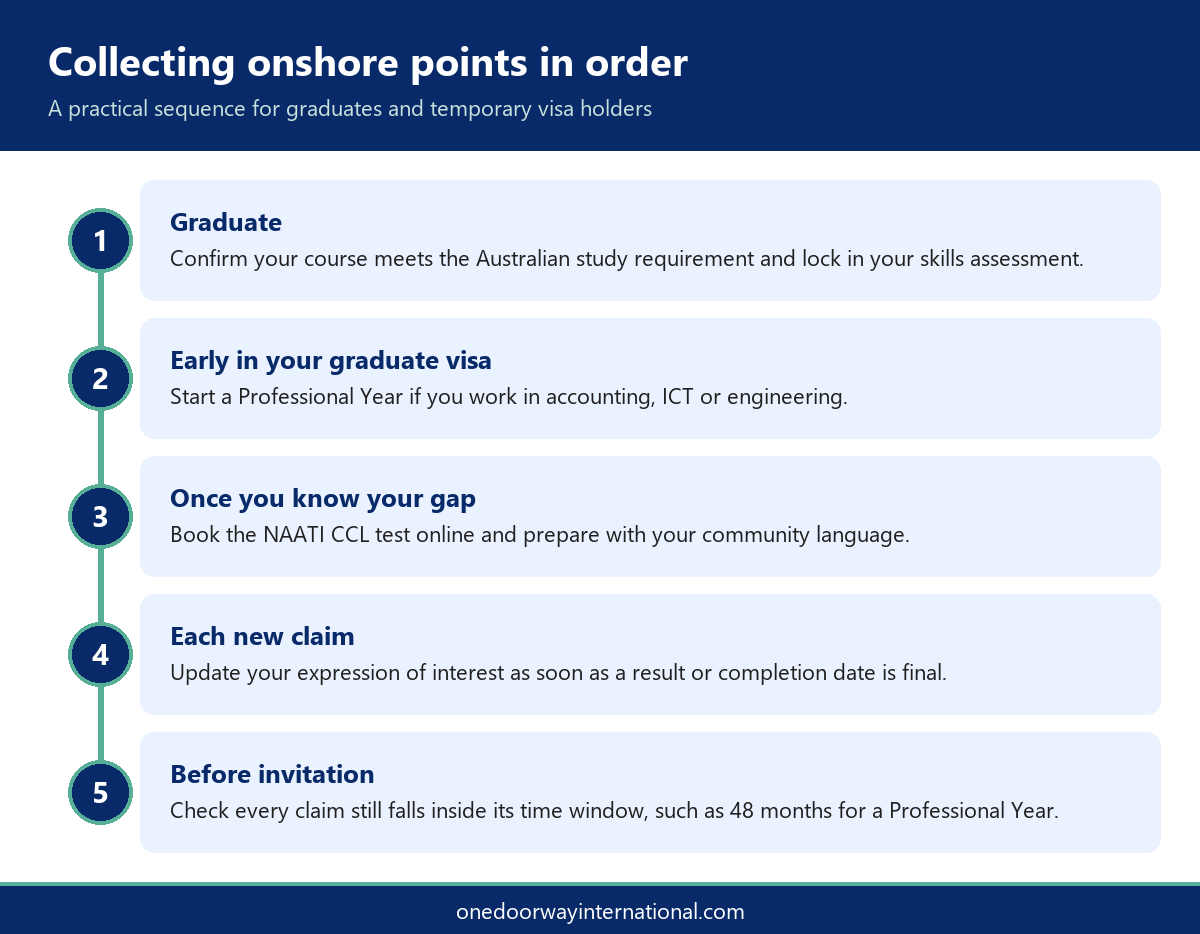
A simple order helps you collect each claim on time:
- Secure Australian study requirement points and your skills assessment soon after you graduate.
- Start a Professional Year early in your graduate visa if your occupation qualifies, so professional year points land well before invitation.
- Book the CCL test once you know the size of your score gap.
- Update your expression of interest each time a new claim becomes final.
Our team handles skilled and general migration visa applications and can show which 189, 190 or 491 visa suits your score.
Conclusion
Onshore factors reward the time you have already invested in Australia. Professional year points, NAATI CCL points, an Australian degree, regional study and local work can together lift your score beyond what many offshore applicants reach. Each claim needs solid evidence and correct timing against your invitation date. Rules and fees change often, so check every value on the official sources before you lodge. To plan your next step, book a consultation with our Narre Warren office and have a registered migration agent review your points and visa timeline.