
If you already live here on a temporary visa, Australia PR requirements look different from the guides written for offshore applicants. Your current visa sets your deadlines, your evidence and your most realistic route. A student on a 500 has different options from a sponsored worker on a 482 or a partner on an 820. This guide sorts the rules by the visa you hold today. You will find the core requirements, one decision path per visa, a timing table based on the months left on your visa, and costs checked as of October 2026.
Key Takeaways
- Australia PR requirements share one core: age, an eligible occupation, a positive skills assessment, competent English, enough points, and health and character checks.
- Your current visa decides the realistic route. Students and graduates usually aim for the 189, 190 or 491, sponsored workers for the 186, and partners for the 801.
- Start at least 12 months before your visa ends, because skills assessments, English tests and nominations all take time.
Start Here: Which Visa Do You Hold Today?
Most guides to Australia PR start with the points test. For people already living here, a better starting point is your visa grant letter. It tells you how long you can stay, which conditions apply and how many months you have left to act. You can confirm your current expiry date and conditions in VEVO, the online visa check at any time.
Five onshore situations cover most of the people we hear from in Melbourne's south east:
- Student visa (subclass 500): You are studying, often in Melbourne or nearby, and want a plan for after graduation.
- Temporary Graduate visa (subclass 485): You have finished your course and are working on a fixed clock.
- Skills in Demand visa (subclass 482): An approved employer sponsors you and you want to stay for good.
- Partner visa (subclass 820): You applied for the temporary and permanent partner visas together and are waiting.
- Bridging visa: You have lodged a new application and are waiting for a decision.
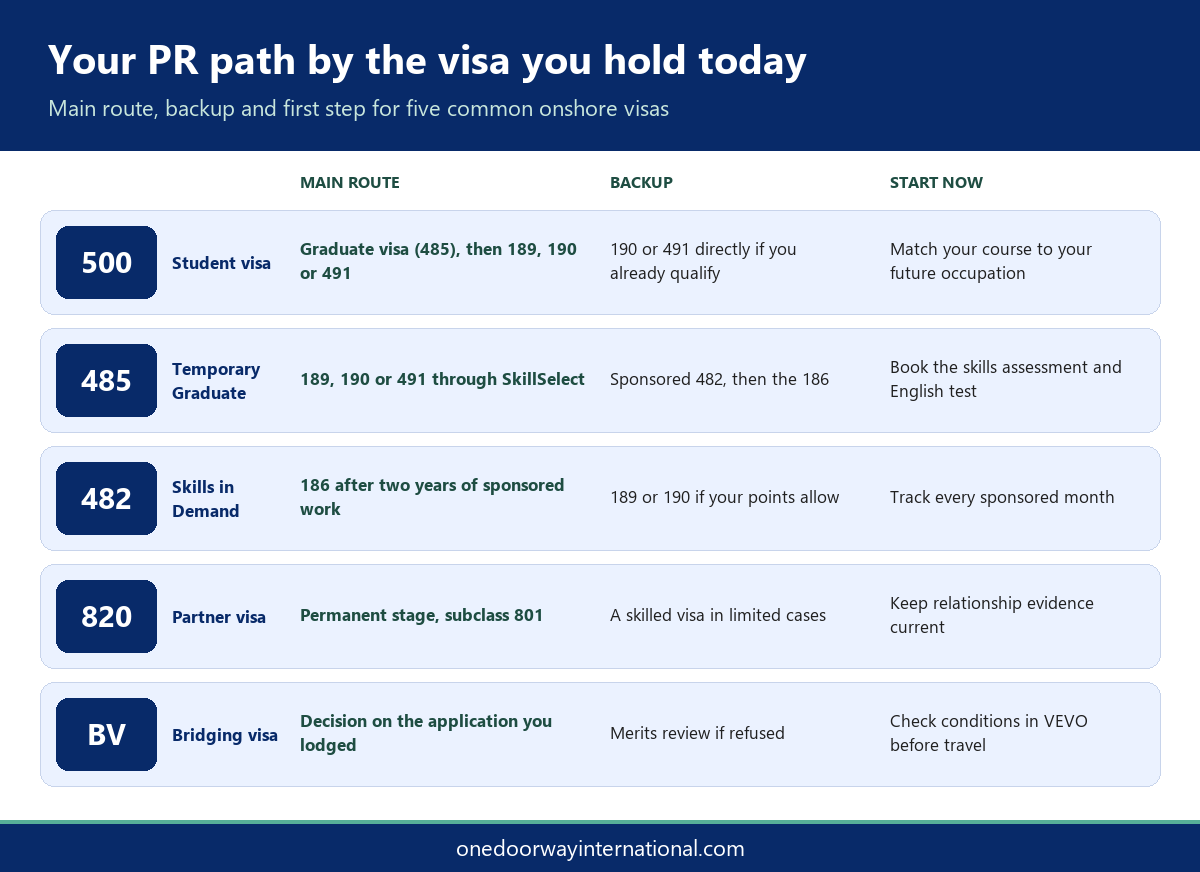
Each situation has a main route and at least one backup. Students and graduates usually look at the points tested visas. Sponsored workers usually look at employer nomination. Partners usually wait for the permanent stage of the partner visa, although a skilled route can still make sense in some cases. People on bridging visas need to protect their lawful status first and plan second.
Your visa also sets your real deadline. A graduate with eight months left cannot follow the same plan as a student with two years left. The sections below cover the shared rules first, then the path from each visa, then a timing table you can use to plan.
If you hold a different visa, such as a Working Holiday visa or a visitor visa, the same core Australia PR requirements still apply. Your Australia PR eligibility will depend on your occupation, age, English, points and any conditions on your current visa. Some of these visas carry conditions that limit what you can apply for while you are in Australia, so check them first.
The Core Australia PR Requirements Every Pathway Shares
The core Australia PR requirements are similar across the skilled routes, even though each visa adds its own rules. If you understand these five building blocks, you can judge your Australia PR eligibility quickly and spot the weak point in your profile early.
Age at Invitation or Application
Age is a hard limit, not just a points factor. For the Skilled Independent (subclass 189) and Skilled Nominated (subclass 190) visas, you must be under 45 when you are invited to apply. The same applies to the Skilled Work Regional (subclass 491) visa. For the Employer Nomination Scheme (subclass 186), you usually must be under 45 when you apply, although Home Affairs lists some exemptions, including certain high earners. These limits were checked on Home Affairs as of October 2026.
Age also earns points, and those points fall as you get older. If you are in your early 40s, every month counts. A future post in this series covers 45th birthday deadlines in detail.
Occupation and Skills Assessment
Your nominated occupation must appear on the list that applies to your chosen visa. Our guide to the MLTSSL, STSOL and other occupation lists explains where common jobs sit. You then need a positive skills assessment from the authority that covers your occupation.
Each authority has its own evidence rules. Our post on which assessing authority covers your job walks through the main ones. Timing matters too. For the 190, Home Affairs states your assessment must have been obtained within three years before your invitation, or within any shorter validity the authority sets. An assessment that expires while you wait for an invitation can stop the process.
English and the Points Test
Most skilled routes require at least competent English. Higher test scores earn extra points, which is often the fastest way to lift a borderline score. Our guide to IELTS and PTE scores for PR shows how each band translates into points.
For the 189, 190 and 491, you need at least 65 points to be invited, as stated by Home Affairs as of October 2026. In practice, invitation rounds often go to people with scores above that minimum. Before you lodge anything, use our step by step points calculation guide to check your real score. Several points sources are only available inside Australia, such as Australian study, a Professional Year, a NAATI credentialled community language and regional study. Each of these will get its own post later in this series.
Health, Character and Your Visa History
Before granting permanent residency, Australia checks that every applicant and most family members meet health and character requirements. That means medical examinations and police certificates from each country where you have lived for a set period.
Your visa history matters as well. Breaches of past visa conditions, such as working beyond your allowed hours, can create problems later. Some visas also carry a No Further Stay condition, which can block most applications made inside Australia. Check your conditions in VEVO before you plan anything. If one appears, get advice before you lodge.
A Quick Self Check
Before you spend money on tests or assessments, answer these six questions honestly. They cover the core Australia PR requirements for most points tested routes.
- Will you be under 45 on the date you expect an invitation?
- Is your occupation on the list for the visa you want?
- Can you get a positive skills assessment with the evidence you hold today?
- Do you have at least competent English, or a test booked?
- Can you prove at least 65 points, with evidence for every claim?
- Do you and your family members expect to meet health and character checks?
A "no" to any question does not end your plan. It tells you where to focus first, and it may point you to a different Australia skilled visa that suits your profile better.
Your Australia PR Pathway From Each Onshore Visa
This is the heart of the guide. For permanent residency, Australia offers different routes to different visa holders. Find your current visa below and read that path first. Then read the backup option, because plans change when invitation rounds, occupation lists or employers change.
Student Visa (Subclass 500)
A student visa does not lead straight to permanent residency in Australia. Most students follow a two step plan. First, finish a CRICOS registered course and apply for a Temporary Graduate visa. Second, use the time on that visa to build points and work experience for a skilled visa.
Some students can go further while still studying. If your occupation is on the right list and you can already meet the age, English, skills assessment and points rules, you can lodge an Expression of Interest for an Australia skilled visa before you graduate. Choose your course with your future occupation in mind. A course that does not match your nominated occupation can make the skills assessment harder later. Our guide to moving from student to graduate to PR covers this path step by step.
Temporary Graduate Visa (Subclass 485)
The 485 is the most common bridge to Australia skilled migration for people who studied here. As of October 2026, Home Affairs states you must usually be aged 35 or under when you apply, and you must have held a Student visa in the last six months. The degree level stream usually gives two to three years of stay, depending on your qualification.
That stay is your working window. Use it to get your skills assessment, sit your English test and gain relevant work experience. Then lodge an Expression of Interest in SkillSelect for the 189, and apply for state nomination for the 190 or 491. Our comparison of the 189, 190 and 491 visas explains the trade offs. If an employer wants to keep you, a sponsored 482 can also lead to the 186 later.
Skills in Demand Visa (Subclass 482)
The 482 is now called the Skills in Demand visa. Home Affairs lists a stay of up to four years. For many sponsored workers, the clearest route to permanent residency in Australia is the Temporary Residence Transition stream of the 186.
As of October 2026, Home Affairs states you usually need two years of eligible sponsored employment in the three years before you apply. Your employer must also nominate you. Our explainer on employer sponsored PR through the 186 sets out the steps. Track your sponsored months carefully from day one. Unpaid leave and changes of employer can affect the count. If your employer cannot nominate you, a points tested Australia skilled visa may still be open if your occupation and points allow it.
Partner Visa (Subclass 820)
If you applied for a partner visa in Australia, you lodged the temporary 820 and the permanent 801 together. Home Affairs states that the permanent stage is usually assessed from two years after you applied. Your path is mostly about keeping your relationship evidence current until then.
Collect evidence of joint finances, shared living arrangements and social recognition as you go. If the relationship ends, or a family violence situation arises, the rules change and you should get advice quickly. Some partners also hold strong skilled profiles. A skilled application can make sense in limited cases, but it needs careful timing so it does not clash with your partner application.
Bridging Visa Holders
A bridging visa keeps you lawful while a substantive visa application is processed. It is not a pathway on its own. Most people receive a Bridging visa A automatically when they lodge a new visa application in Australia before their current visa ends.
According to Home Affairs, a Bridging visa A does not support return travel and ends if you leave Australia. If you need to travel, you must apply for a different bridging visa first. Your Australia PR requirements depend on the application you are waiting on, so your job now is to respond quickly to requests and avoid any breach of conditions.
Living in Regional Victoria or Planning a Move
If you already live in Victoria, state nomination for the 190 may suit you, because states often favour people who already live and work there. The 491 is a provisional visa that requires you to live, work and study in a designated regional area. Home Affairs states you can apply for permanent residence after three years from the grant, through the Permanent Residence (Skilled Regional) visa.
Metropolitan Melbourne is generally not a designated regional area, so a move from Narre Warren or Dandenong to a regional centre would be part of this plan. Check your postcode against the official list before you commit. Separate posts in this series will cover 190 nomination in Victoria and 491 options in regional Victoria in more detail.
Months Left on Your Visa: What to Start and When
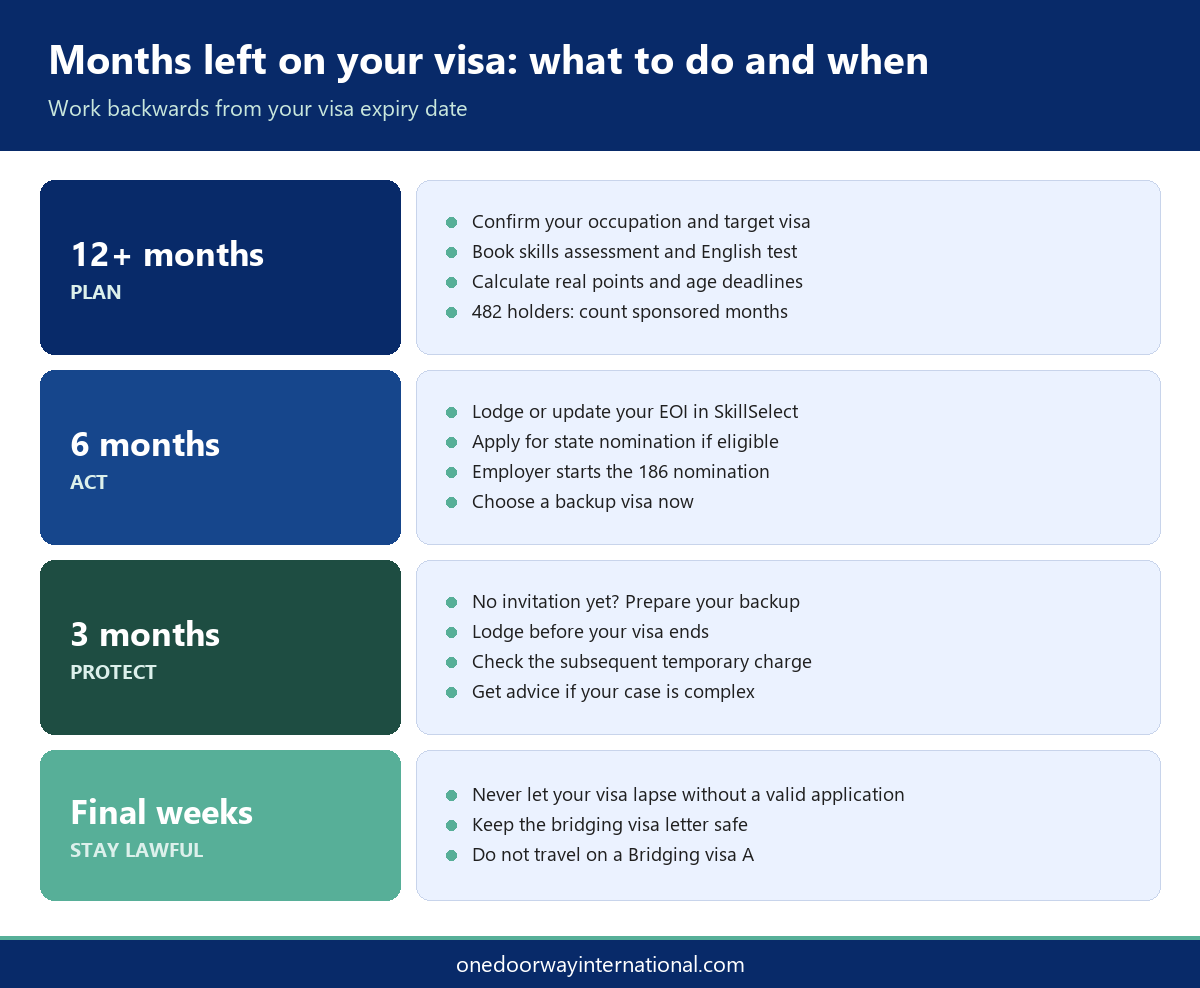
Most stalled Australia PR plans fail on timing, not eligibility. The skills assessment takes longer than expected, an English test result arrives late, or an invitation never comes before the visa ends. Use this timing table to meet the Australia PR requirements in the right order, working backwards from your expiry date.
12 Months or More Left
This is your planning window. Confirm your occupation is on the right list and choose your target visa for Australia skilled migration. Book your skills assessment and English test, because both take time and you may want a second attempt. Work out your real points score and note any birthday that will change it. If you hold a 482, count your sponsored months and talk to your employer about nomination.
6 Months Left
This is your action window. Lodge or update your Expression of Interest in SkillSelect. If you live in Victoria, look at the state nomination options and how states compare. Ask your employer to start the nomination if you are on the 186 path. At this point, also pick a backup visa that would keep you lawful if no invitation arrives.
3 Months or Less Left
This is your safety window. If no invitation has arrived, prepare and lodge your backup application before your visa ends. Common backups include another 485 stream, a new student visa or a 482 if an employer will sponsor you. Many further temporary visas lodged in Australia attract a Subsequent Temporary Application Charge, so check the current amount. Never let your visa expire without a valid application in place. Home Affairs has a page on what to do when your visa is about to expire that lists your options.
Costs, Processing Times and Bridging Visas at a Glance
Meeting the Australia PR requirements costs money as well as time. Visa charges change on 1 July most years, so treat any figure as a snapshot. The figures below are the base charges for the main applicant, as listed by Home Affairs as of October 2026. They do not include family members, second instalments, health checks, police certificates, skills assessments or English tests.
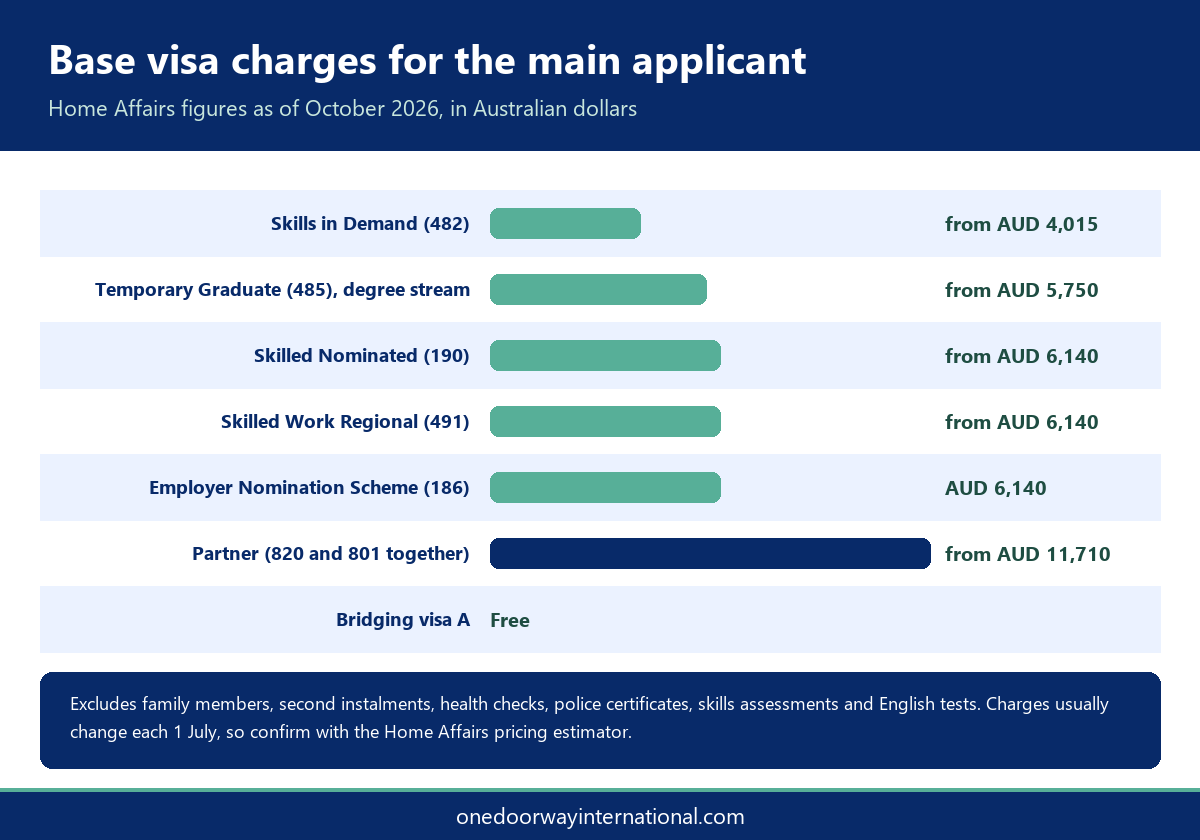
- Skills in Demand (482): from AUD 4,015.
- Temporary Graduate (485), degree stream: from AUD 5,750.
- Skilled Nominated (190) and Skilled Work Regional (491): from AUD 6,140.
- Employer Nomination Scheme (186): AUD 6,140.
- Partner (820 and 801, applied together): from AUD 11,710 for most applicants.
- Bridging visa A: free.
The visa charge is only part of the budget for Australia skilled migration. You will also pay for your skills assessment, English tests, medical examinations, police certificates and certified translations where needed. Some people sit an English test more than once to reach a higher points band. If you include a partner or children, each adds their own charges and checks. Build these costs into your plan early, so a fee does not delay a lodgement date.
For your own case, use the official visa pricing estimator, which reflects the current charges.
Processing Times and Onshore Priority
Processing times move often. As of October 2026, Home Affairs reported that it was processing points tested 189 applications lodged in or before June 2026 where the applicant was in Australia at lodgement. Applications from outside Australia sat further back. That suggests onshore applicants currently receive some priority, but it can change at any time. Check the official processing time guide before you plan around a date.
Bridging Visas While You Wait
Lodging a valid application before your current visa ends usually gives you a bridging visa. Your work rights while on that bridging visa depend on its conditions, which you can check in VEVO. If your application is refused, strict review deadlines apply. Our appeals and reviews team can explain your options with the Administrative Review Tribunal.
Common Mistakes That Stall Onshore Australia PR Plans
We see the same avoidable problems again and again. Most of them come down to timing or evidence, and most can be fixed with early planning. Each one can push you outside the Australia PR requirements for your chosen visa at the worst moment.
- Letting a skills assessment expire. Many assessments are valid for a limited period. Check the expiry date against your likely invitation date.
- Turning 45 before an invitation. For the 189, 190 and 491, the age test applies at invitation, not at the time you lodge your Expression of Interest.
- Relying on one Expression of Interest. Consider every Australia skilled visa and state you are eligible for, so one closed program does not end your plan.
- Claiming points you cannot prove. Every claim needs evidence on the day you are invited. Overclaiming can lead to refusal.
- Leaving Australia on a Bridging visa A. Your bridging visa ends when you depart, and you may not be able to return on it.
- Missing a review deadline. Refusal letters set strict time limits. Read yours the day it arrives.
- Changing occupation too late. A new occupation can mean a new skills assessment and a different list. Decide early.
- Using an unregistered adviser. Only registered migration agents and some legal practitioners can give immigration assistance in Australia.
Most of these mistakes cost months, and some cost the whole pathway. A short review of your plan a year before your visa ends is usually cheaper than fixing a refusal later.
When to Speak With a Registered Migration Agent in Narre Warren
You do not need an agent to apply. Many people lodge their own applications successfully. Advice is most useful when your Australia PR eligibility is borderline, your timing is tight, your occupation sits on a borderline list or your history includes anything unusual. Examples include a past visa refusal, a No Further Stay condition, a change of employer or a relationship change.
One Doorway International has a registered migration team in Narre Warren that serves people across Casey, Dandenong and Cardinia. For Australia skilled migration, we help with skilled visa applications, partner visa applications, employer sponsored visas, student visas and review applications.
To get the most from a first meeting, bring your current visa grant letter, your passport, your qualifications, your employment records and any English test results. If you already hold a skills assessment, bring that too. With these documents, an agent can check your Australia PR eligibility, confirm your real deadline and map the order of your next steps. It also helps to list your questions in advance, such as which state to target or whether your partner can add points.
Before you choose any adviser, check their registration on the official Register of Migration Agents. A registered agent cannot promise a visa outcome, and you should be wary of anyone who does.
Conclusion
Australia PR requirements start with the same core: age, occupation, skills assessment, English, points, health and character. What changes is your route, and that depends on the visa you hold today. Students and graduates usually build towards the 189, 190 or 491. Sponsored workers usually aim for the 186. Partners usually wait for the 801. Whatever your visa, start a year before it ends and always keep a lawful backup. If you want a clear Australia PR plan for your situation, book a consultation with our Narre Warren team today.