
The 491 visa conditions decide where you can live, work and study for the next five years. If you are in Narre Warren, Dandenong or Casey on a student, graduate or work visa, a state nomination for regional Victoria can look like a fast route to permanent residence. It can be. But a Melbourne lease will not count, and some suburbs a short drive away will. This guide explains which nearby areas qualify, what condition 8579 asks of you, and how to keep records that hold up when you apply for the 191.
Key Takeaways
- The 491 visa conditions require you and your family to live, work and study in a designated regional area. Melbourne metro does not qualify, but some outer south east postcodes do.
- The 491 to 191 PR pathway needs three years on the 491, compliance with your conditions and ATO notices of assessment for three income years. There is no minimum income, as of October 2026.
- Start an evidence file on day one. Leases, bills, payslips and school reports prove regional residence far better than memory.
491 Visa Requirements Before You Move
The 491 is a five year provisional visa. It is the main regional visa Australia offers to skilled workers who do not have an employer sponsor. Before you plan a move, check that you meet the core 491 visa requirements published by Home Affairs.
The first of the 491 visa requirements is a nomination from a state or territory government agency, or sponsorship by an eligible relative who usually lives in a designated area. The 491 visa requirements apply at invitation and grant, while the conditions apply for the life of the visa. Your occupation must be on the relevant list, and you need a suitable skills assessment. You must be invited through SkillSelect and pass the points test score on your invitation. You must also be under 45 when invited.
If you are still choosing between programs, our guide on how the 189, 190 and 491 compare sets out the trade offs. Each state also runs its own nomination criteria, so read our notes on choosing a nominating state before you lodge an expression of interest. Meeting the 491 visa requirements gets you the visa. The 491 visa conditions decide whether you keep the pathway open.
Which Areas Near Melbourne's South East Count as Regional
Home Affairs states that most of Australia outside Sydney, Melbourne and Brisbane is a designated regional area. Melbourne metro is not regional. Inside Victoria, the list has two regional categories. Geelong is a Category 2 "Cities and Major Regional Centres" area. Category 3 covers "Regional Centres and Other Regional Areas", which includes places such as Ballarat, Bendigo and the Latrobe Valley.
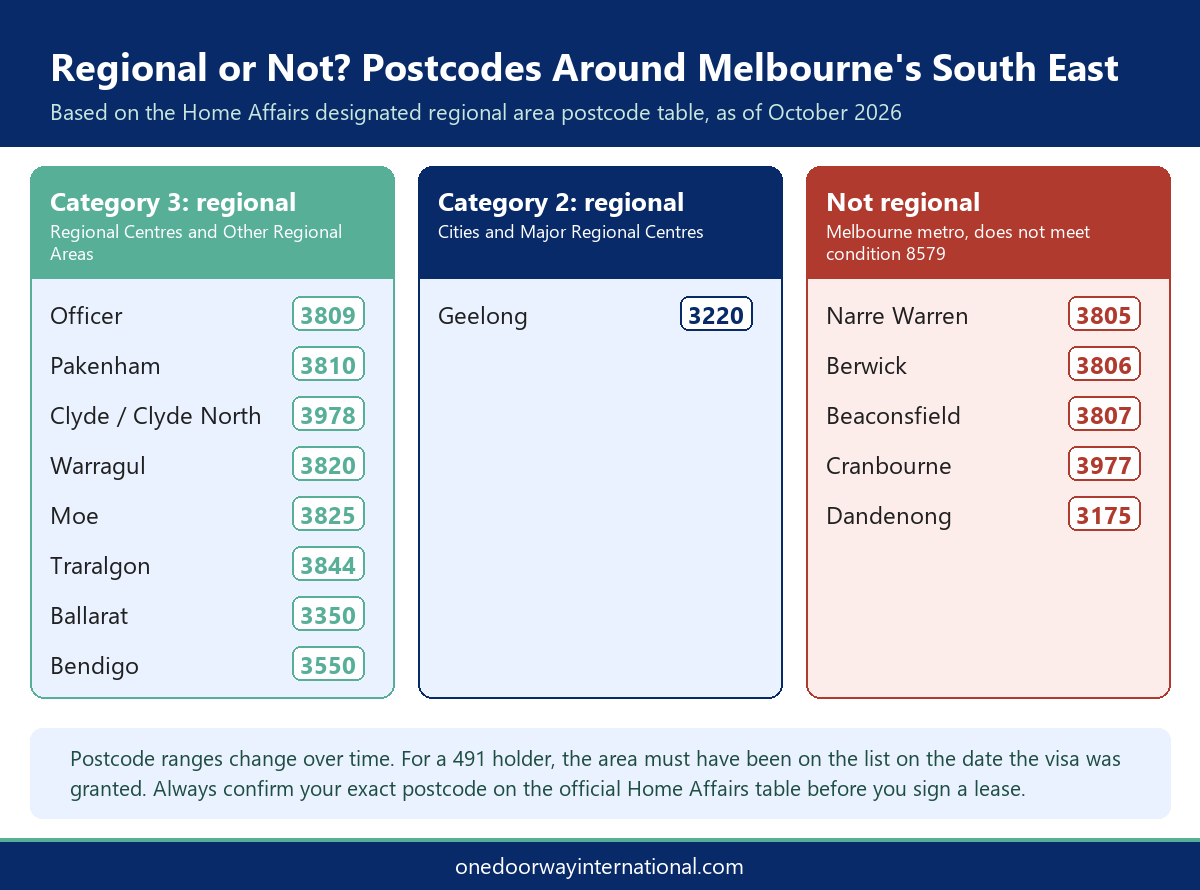
The official list works by postcode, not by suburb name or council. As of October 2026, the designated regional area postcodes page lists Victorian Category 3 ranges that include 3809 to 3909 and 3978 to 3996. The same postcode list applies to each regional visa Australia offers skilled migrants, including the 491 and 494. That means some areas close to the Narre Warren office fall inside the list:
- Officer (3809) and Pakenham (3810) sit inside the 3809 to 3909 range.
- Clyde and Clyde North (3978) sit inside the 3978 to 3996 range.
- Warragul (3820), Moe (3825) and Traralgon (3844) are further east in Gippsland.
Narre Warren (3805), Berwick (3806), Beaconsfield (3807), Cranbourne (3977) and Dandenong (3175) are not in the regional ranges. Two streets apart can mean two different answers, so check the exact postcode on the Home Affairs table before you sign a lease. Under the 491 visa conditions, the area must have been on the list on the date the visa was granted. The address test comes first, so get it right before you move. A later change to the list does not move your goalposts.
Condition 8579: Living, Working and Studying Regionally
Condition 8579 sits at the heart of the 491 visa conditions. It applies to you and to every family member who holds the visa. It is also what separates a regional visa Australia grants from a standard skilled visa. Home Affairs has described it in a policy note released under Freedom of Information: you must live at a residential address in a designated regional area. You must also usually spend your work hours performing your duties from a work location in a designated area.
The 491 visa conditions look at where you work, not where your employer is based. Your employer does not have to be regional. A Melbourne company with a local branch in Pakenham can work, if you work from that branch. A 2023 departmental policy minute also clarified that routine remote work from a regional home office can count, as long as you are not routinely or frequently working in a metropolitan area.
This is where south east households get caught. Under the 491 visa conditions, living in Officer but driving to a Dandenong warehouse every day is a real risk. The address passes. The work location may not.
Holidays, work travel and training outside the region are generally treated as incidental. Under the same policy note, officers may ask why you were away if you spend more than 90 days in a year outside the area, or more than 60 days in a row. Treat those numbers as review triggers, not allowances, and check the current policy before you travel. Children on the visa should attend school in the regional area too, since study is part of the same rule. Breaching the 491 visa conditions can lead to cancellation, and it can block the 191.
The 491 to 191 PR Pathway: Residence, Income and Timing
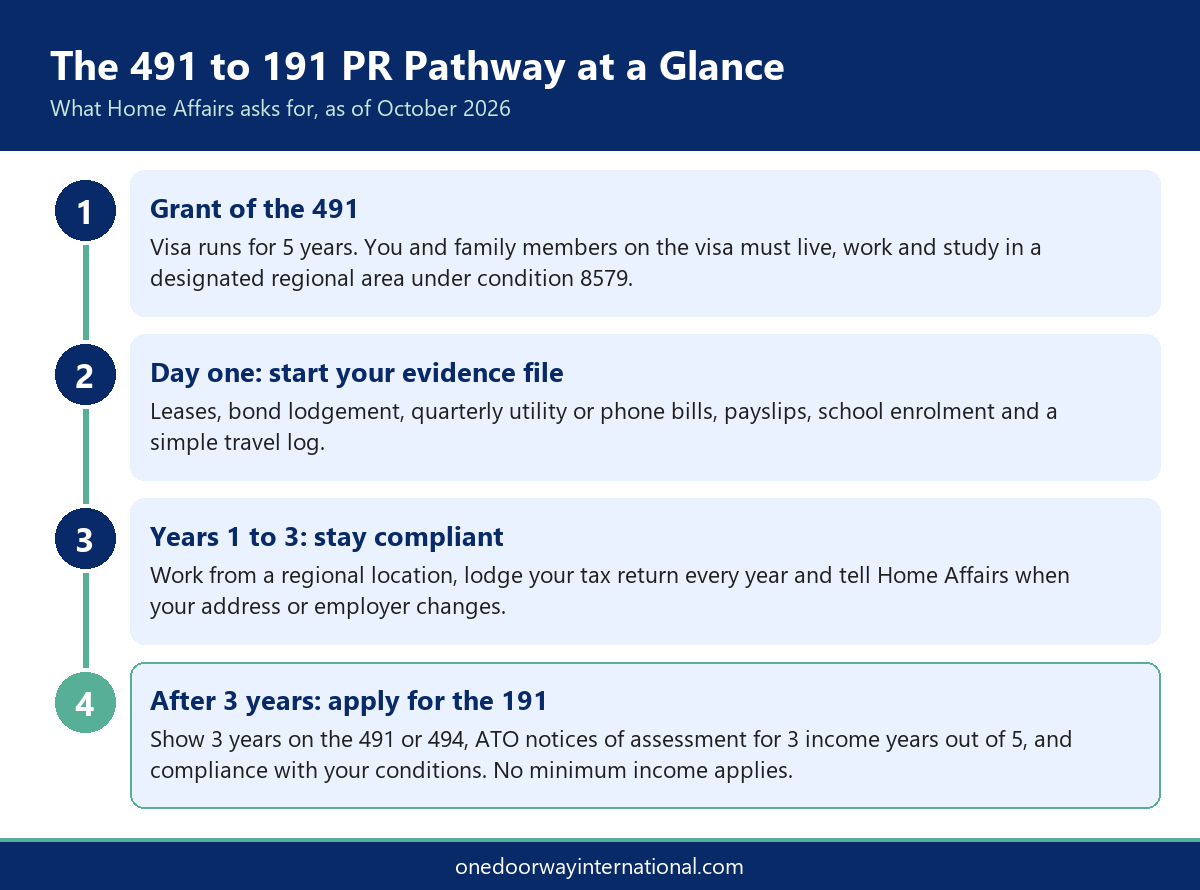
The 491 to 191 PR pathway is the main reason people accept regional living. The Permanent Residence (Skilled Regional) visa (subclass 191) asks for three things on top of health and character checks.
- You must have held a 491 or 494 visa for at least three years before you apply.
- You must provide ATO notices of assessment for three income years out of the five years of your eligible visa. As of October 2026, there is no minimum income requirement.
- You must have complied with the 491 visa conditions, or the 494 conditions, for the whole time you held the visa.
Many older guides still quote a taxable income threshold for the 191. The current Permanent Residence (Skilled Regional) visa page says no minimum income applies. If you owe money to the ATO, it must be repaid or covered by an approved payment plan.
Timing matters on the 491 to 191 PR route. Until you have held the 491 for three years, you generally cannot be granted other permanent skilled visas such as the 189, 190 or 186. Plan your career moves inside that window. A regional visa Australia grants for five years still gives you room, but only if your tax returns and residence records line up.
How to Keep Evidence That You Met the 491 Visa Conditions
The 191 application asks you to prove you lived, worked and studied in a designated area. Home Affairs lists leases or rental agreements, utility bills showing your home address, title deeds, payslips, reference letters, school reports and academic transcripts as examples. Build that file from your first week, not in year three. A complete file makes the 491 to 191 PR step far smoother.
A simple routine works well:
- Keep every lease, renewal and bond lodgement in one folder.
- Save one utility or phone bill per quarter that shows your regional address.
- Download payslips monthly and ask each employer for a reference letter when you leave.
- Lodge your tax return on time each year so the notices of assessment exist when you need them.
- Keep a short travel log of dates outside the region and the reason for each trip.
The wider 491 visa conditions also let officers ask for your current contact details, your employer and work location, and evidence of where you have lived. They can also ask you to attend an interview. Tell Home Affairs when your address or employer changes. Any regional visa Australia issues with these conditions rewards people who keep tidy records. If you are weighing up a move, our skilled migration services cover nomination, the 491 application and the 191 that follows.
Conclusion
Moving from Melbourne to regional Victoria can open a clear road to permanent residence. The trade off is discipline. Understand the 491 visa conditions before you choose a suburb, check the exact postcode on the Home Affairs list, and make sure your work location is regional too. Then keep three years of clean evidence for the 191. If you want a second opinion on a nomination, a lease or a job offer, book a consultation with our Narre Warren office. Our MARA registered team can review your plan against the rules in force today.