

If you already live in Melbourne or regional Victoria, the subclass 190 visa can turn a temporary stay into permanent residence without an employer sponsor. The catch is that Victoria must choose you first. That choice starts with a Registration of Interest and rests on evidence: where you live, where you work and how you rank. This guide explains how the ROI works for onshore applicants, which Victorian documents matter, how to lift your ranking and what to do if no invitation arrives. Figures are current as of October 2026.
Key Takeaways
- Victoria state nomination for the subclass 190 visa starts with a SkillSelect EOI plus a Victorian ROI, ranked by the Victorian Points Test rather than your 190 points calculator score alone.
- Consistent proof that you live and work in Victoria is the backbone of a strong ROI.
- An ROI lapses at the end of its program year, so plan a backup skilled nominated visa or employer pathway early.
How the Victorian ROI Works for Subclass 190 Visa Applicants
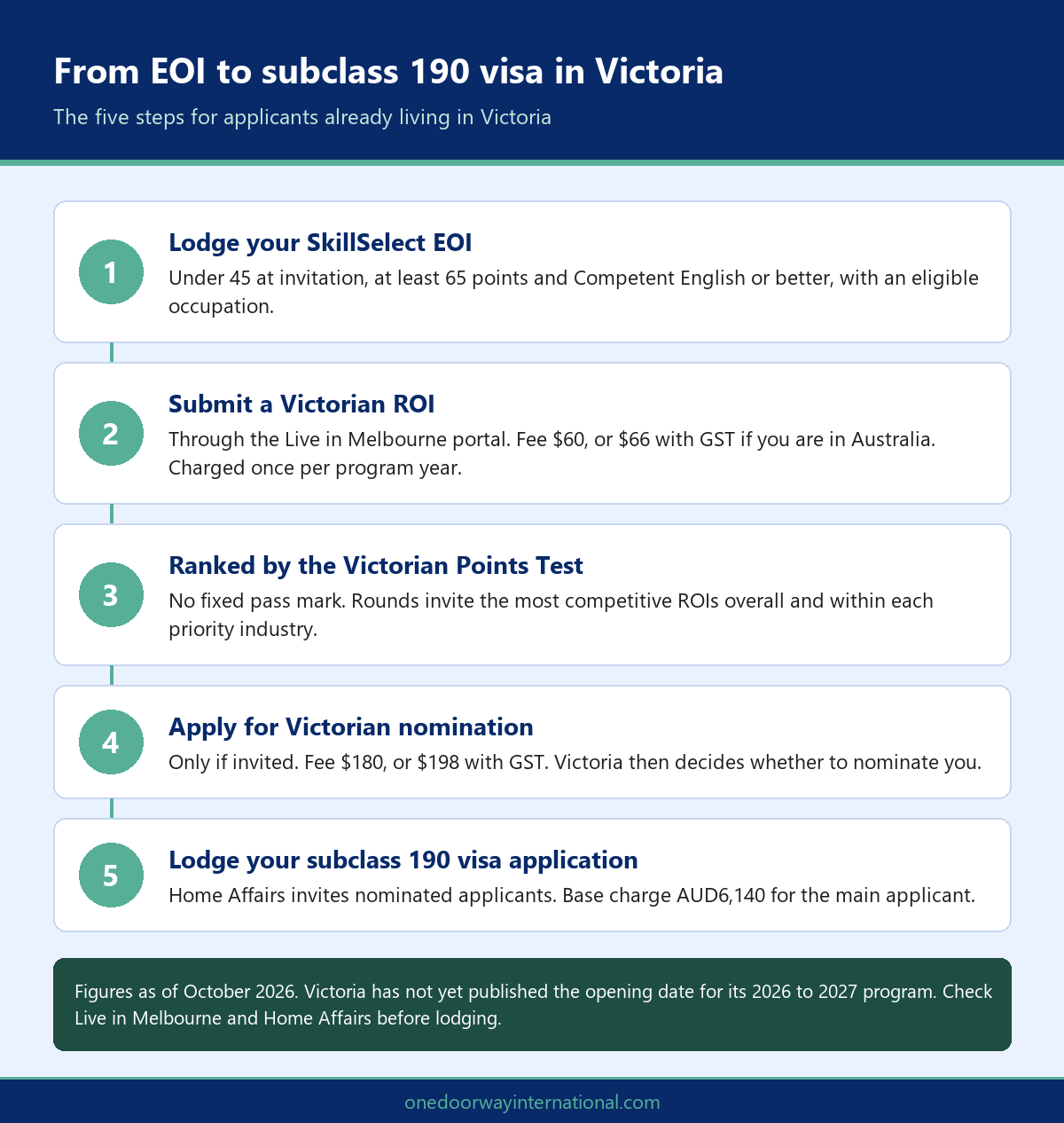
Victoria state nomination is a two step process. First, you lodge an Expression of Interest (EOI) in SkillSelect for the subclass 190 visa. Then you submit a Registration of Interest (ROI) to Victoria through the Live in Melbourne portal. Victoria invites selected ROIs to apply for nomination. If Victoria nominates you, Home Affairs then invites you to apply for the visa itself.
Home Affairs sets the federal floor for the skilled nominated visa. You must be under 45 when invited, score at least 65 points and hold at least Competent English at invitation, according to the Home Affairs Skilled Nominated visa page. Your occupation must also be on the eligible list.
Your federal score still matters. Run a 190 points calculator before you lodge, and count every claim you can document. Onshore applicants often hold points for Australian study, a professional year or skilled work in Australia. A Victorian nomination adds further points once Victoria grants it.
As of October 2026, Victoria has published its fees for the 2026 to 2027 program but not its opening date. The ROI fee is $60, or $66 with GST if you are in Australia when you pay. A subclass 190 visa nomination application costs $180, or $198 with GST, and you pay it only if invited. The previous program closed to new ROIs in April 2026, and an old ROI does not carry over. You must lodge a fresh one when the program opens.
Still deciding between states? Our guide on choosing which state to apply to compares the options. This article assumes you have already chosen Victoria.
Evidence of Victorian Residence and Employment
Recent Victorian programs have focused onshore nominations on people already living and working in Victoria. The detailed 2026 to 2027 eligibility rules for the subclass 190 visa had not been republished when we checked in October 2026. Confirm them on Live in Melbourne before you lodge. Whatever the final wording, your evidence should prove two things clearly.
Proof that you live in Victoria. Gather documents that show a Victorian address over time, not just today:
- A signed residential lease, or a letter from the person you board with
- Utility, internet or phone bills in your name
- Bank statements showing your current address
- A Victorian driver licence, or ATO and Medicare letters sent to that address
Proof that you work in Victoria. For work in your nominated occupation, keep:
- An employment contract and a reference letter listing your duties and hours
- Recent payslips and your ATO income statement
- Superannuation records that match your employer and dates
Gaps, moves and shared housing. If you moved within Victoria, keep evidence for each address. If you rent a room with no lease in your name, a statutory declaration from the leaseholder, backed by your bank statements, may help fill the gap. Explain any time spent interstate or overseas rather than leaving it unexplained.
Consistency matters more than volume. Your address, job title, dates and pay should match across your EOI, ROI, skills assessment and documents. A mismatch can cost you an invitation or lead to a refusal later. Victoria also asks nominees to sign a Nomination Declaration, which you can preview on Live in Melbourne. Read it before you commit to a subclass 190 visa nomination, because a skilled nominated visa comes with real expectations about where you will live.
How to Strengthen Your ROI Under the Victorian Points Test
Victoria ranks every ROI using the Victorian Points Test, or VPT. It has no fixed pass mark. In each invitation round, Victoria invites the highest ranked ROIs overall, plus the highest ranked within each priority industry. A strong 190 points calculator result keeps you eligible for the subclass 190 visa, but the VPT decides your place in the queue.
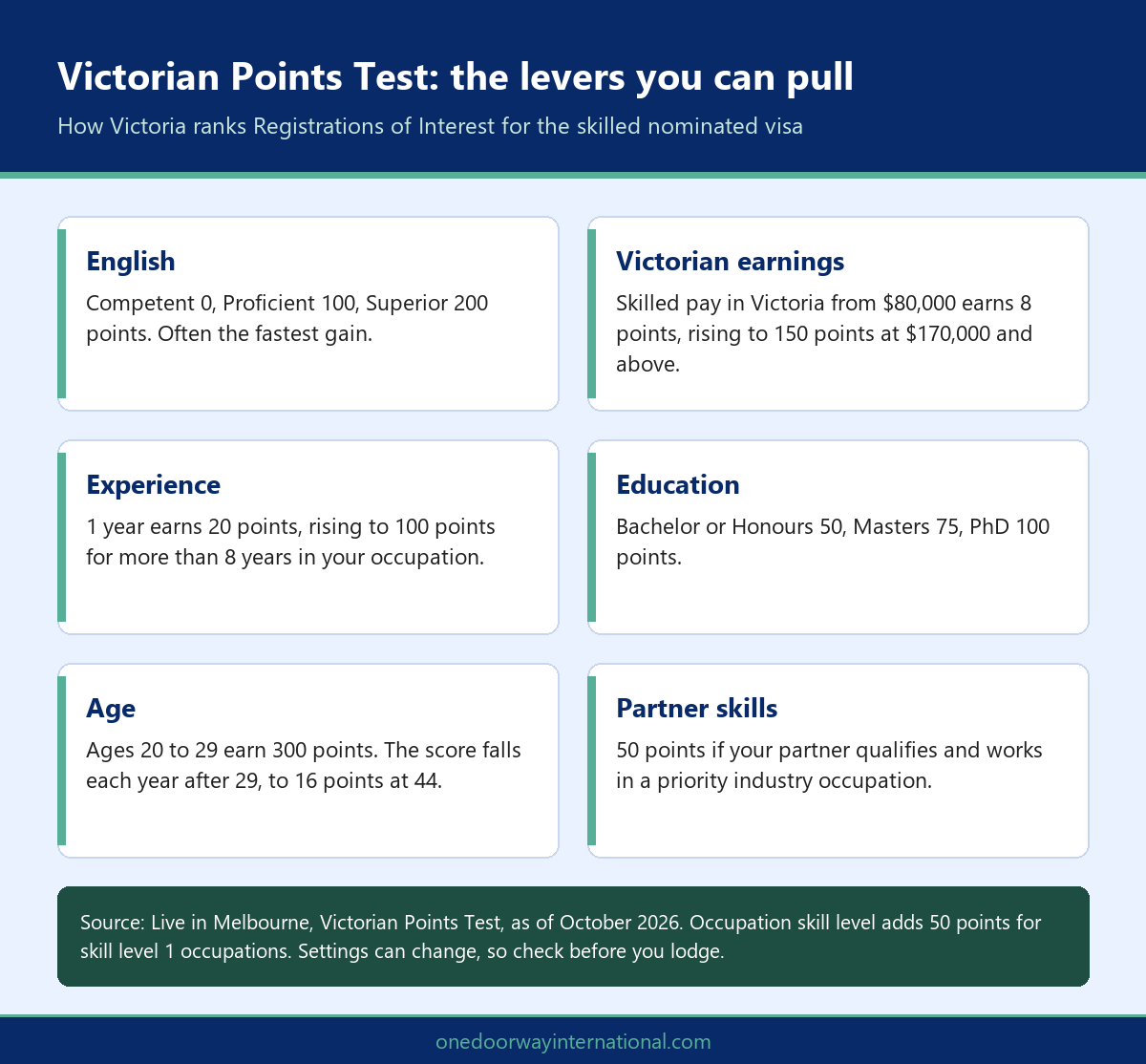
The VPT weighs seven factors: age, English, years of experience in your occupation, education, occupation skill level, partner skills and annual earnings from skilled employment in Victoria. As of October 2026, the published weightings reward these levers most:
- English. Proficient English adds 100 VPT points and Superior adds 200, while Competent adds none. A better test result is often the fastest gain. Our guide to IELTS and PTE scores for PR explains the test options.
- Victorian earnings. Skilled employment in Victoria paying $80,000 or more a year attracts points, rising to 150 points at $170,000 and above.
- Experience. Each extra band of experience in your nominated occupation lifts your total, up to 100 points for more than eight years.
- Partner skills. You can gain 50 points if your partner meets the partner skills rules and works in a current priority industry occupation.
- Age and education. These carry heavy weight but are harder to change. Applicants aged 20 to 29 receive the top age score, so timing your subclass 190 visa plans early helps.
Next, check whether your occupation sits in a 2026 to 2027 priority industry. The published list covers health, social services, teaching, early childhood education and construction roles, including many nursing and trade occupations. Then rerun a 190 points calculator for your federal score, so both rankings stay current. If your circumstances change, you can withdraw and resubmit your ROI within the same program year without paying the fee again.
What to Do If No Invitation Comes
Victoria state nomination is competitive, and limited places mean strong applicants still miss out. Victoria does not tell applicants how their score compares with others, and an invitation is never guaranteed. It also will not prioritise you because your current visa is about to expire. So plan for a no as carefully as a yes.
- Track your visa expiry. Map the date your current visa ends against the program timeline, and get advice well before it lapses. An EOI or ROI for a subclass 190 visa does not keep you lawful on its own.
- Keep improving your VPT. Retake English, add months of skilled work in Victoria and keep your skills assessment valid. Recheck your 190 points calculator total after each change.
- Resubmit next program year. An ROI is valid only for the program year in which you lodge it, so submit a fresh one when Victoria state nomination reopens.
- Compare other skilled routes. Regional nomination, the independent 189 and the skilled nominated visa suit different profiles. Our breakdown of the 189, 190 and 491 visas shows how they differ.
- Talk to your employer. If your employer values your work, employer sponsorship may offer a parallel path to permanent residence.
Many people keep a subclass 190 visa plan alive while pursuing a second option. That way, a missed round becomes a delay rather than a dead end. Our skilled migration team can review both tracks together and flag gaps in your evidence.
Conclusion
The subclass 190 visa rewards people who already live and work in Victoria, but only when their evidence is clear and consistent. Lodge a sound EOI, prepare a well documented ROI and lift the VPT factors you can control, such as English and Victorian earnings. Watch Live in Melbourne for the 2026 to 2027 Victoria state nomination opening date and keep a backup pathway ready. If you want an expert review before you submit, book a consultation with our Narre Warren office. Our MARA registered team can check your documents and options.