

If you already live in Australia on a student, visitor or work visa, your next visa may cost more than the base fee suggests. The subsequent temporary application charge is an extra amount Home Affairs adds when certain onshore applicants apply for another temporary visa. Many students and graduates in Melbourne's south east only discover it at the payment screen. This guide explains who pays it, which visas it covers and which exemptions remove it. It also shows how to plan for it inside your wider budget on the road to permanent residency.
Key Takeaways
- The subsequent temporary application charge applies per person when you apply in Australia for certain temporary visas after an earlier onshore temporary application.
- Permanent, bridging, 485 and partner applications do not attract the STAC visa fee, and applying from outside Australia removes it.
- Treat the charge as one line in your total Australia PR cost and confirm the current amount with Home Affairs before you lodge.
What Is the Subsequent Temporary Application Charge?
Every visa application charge Australia sets is made of parts. There is a base charge for the main applicant and additional charges for each family member. The subsequent temporary application charge sits on top of these. Home Affairs says it applies to certain temporary visas and is payable by each person in the application, based on their own visa history.
That last point matters. In one family application, the main applicant may pay nothing extra while a partner pays the charge. This happens when the partner applied for an earlier visa from inside Australia. Home Affairs walks through this exact situation on its official STAC guidance page.
The charge targets people who move from one temporary visa to the next while staying onshore. It never applies to permanent, bridging, criminal justice or enforcement visas. So the subsequent temporary application charge affects the temporary steps on your journey, not your final PR lodgement.
Think of it as a surcharge on repeat onshore applications. It is separate from the base visa application charge Australia sets for each subclass, so a quick look at the headline fee will not reveal it.
Which Visas Trigger the STAC Visa Fee?
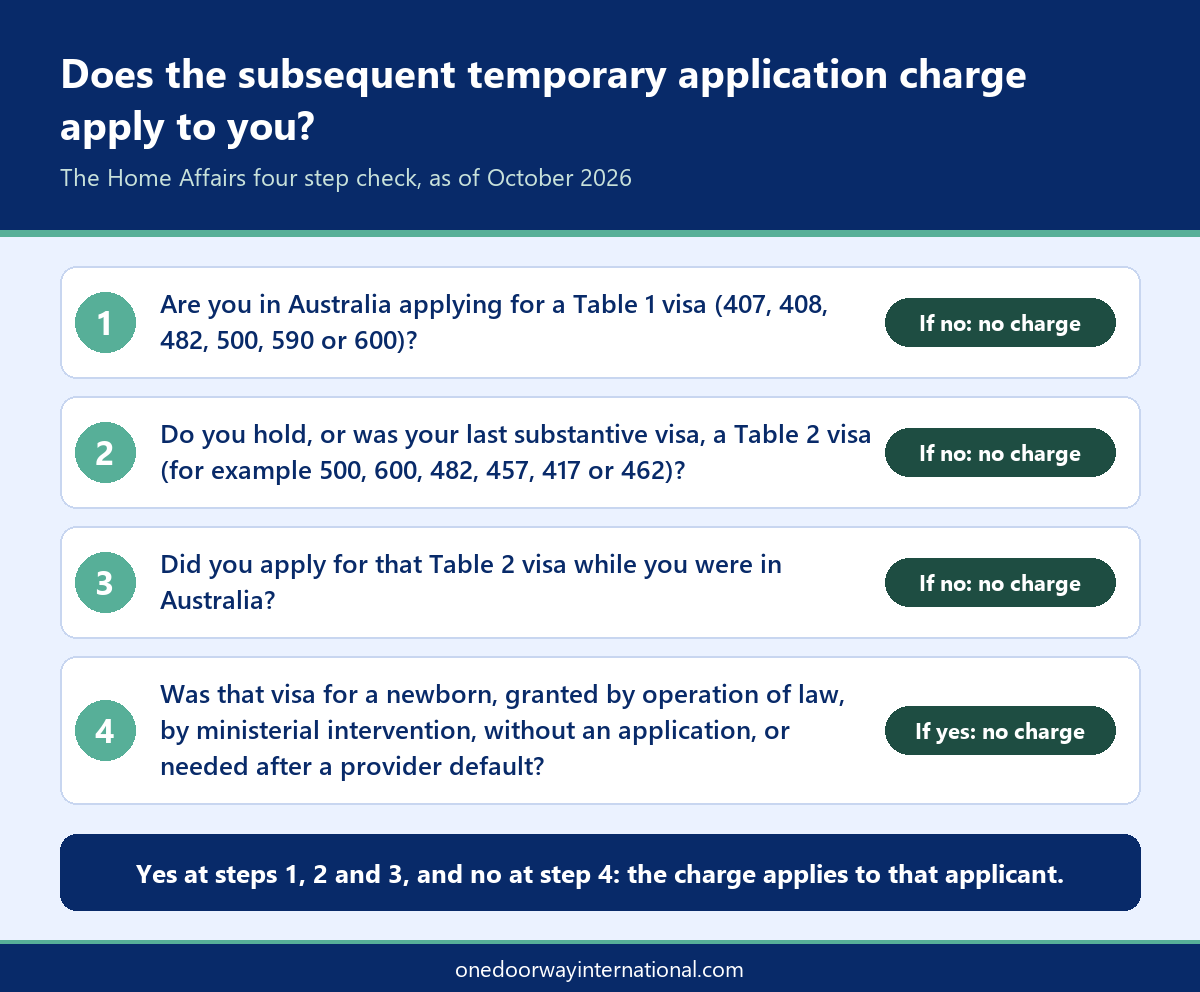
To decide whether this extra amount joins the visa application charge Australia applies to you, Home Affairs uses two lists. Table 1 covers the visa you are applying for now. Table 2 covers the visa you hold, or the last substantive visa you held. You pay only when both tables match your situation and you applied for that earlier visa while in Australia.
As of October 2026, the Table 1 visas are:
- Temporary Activity (subclass 408)
- Training (subclass 407)
- Skills in Demand (subclass 482)
- Student (subclass 500)
- Student Guardian (subclass 590)
- Visitor (subclass 600)
Table 2 includes the Student 500, Visitor 600, both versions of the 482, the older 457, the 407 and 408, Working Holiday 417 and Work and Holiday 462. It also lists the 590, the medical treatment visas and a few specialised subclasses.
Unsure which visa counts as your last substantive visa? Check your VEVO record or your grant letters. Bridging visas are not substantive visas, so a bridging visa held between applications does not change the check.
Notice what is missing. The Temporary Graduate (subclass 485) visa is on neither table, and partner visas such as the 820 are not on Table 1. That is why a student renewing a student visa from inside Australia can face the STAC visa fee, while a graduate lodging a 485 does not.
Exemptions That Bring the Charge to Zero
A visa on Table 1 does not always mean you pay. As of October 2026, Home Affairs lists these exemptions to the subsequent temporary application charge:
- You are outside Australia when you make the substantive temporary visa application.
- It is your first substantive temporary visa application made in Australia.
- The base charge for your visa is nil, or the pricing table shows the charge as nil, N/A or not at all.
- Your earlier Table 2 visa was granted to a child born after the main applicant applied, by operation of law, through ministerial intervention, or without an application.
- Your earlier student visa was one you had to apply for because your education provider defaulted and could not deliver your course.
The first two exemptions are the ones most people rely on. A student whose first 500 was granted offshore can usually lodge one further 500 onshore without the charge. The subsequent temporary application charge normally starts with the onshore application after that.
Exemptions are assessed per applicant too. One person in your application can qualify for an exemption while another still pays the STAC visa fee.
How the Charge Plays Out on Common Onshore Pathways
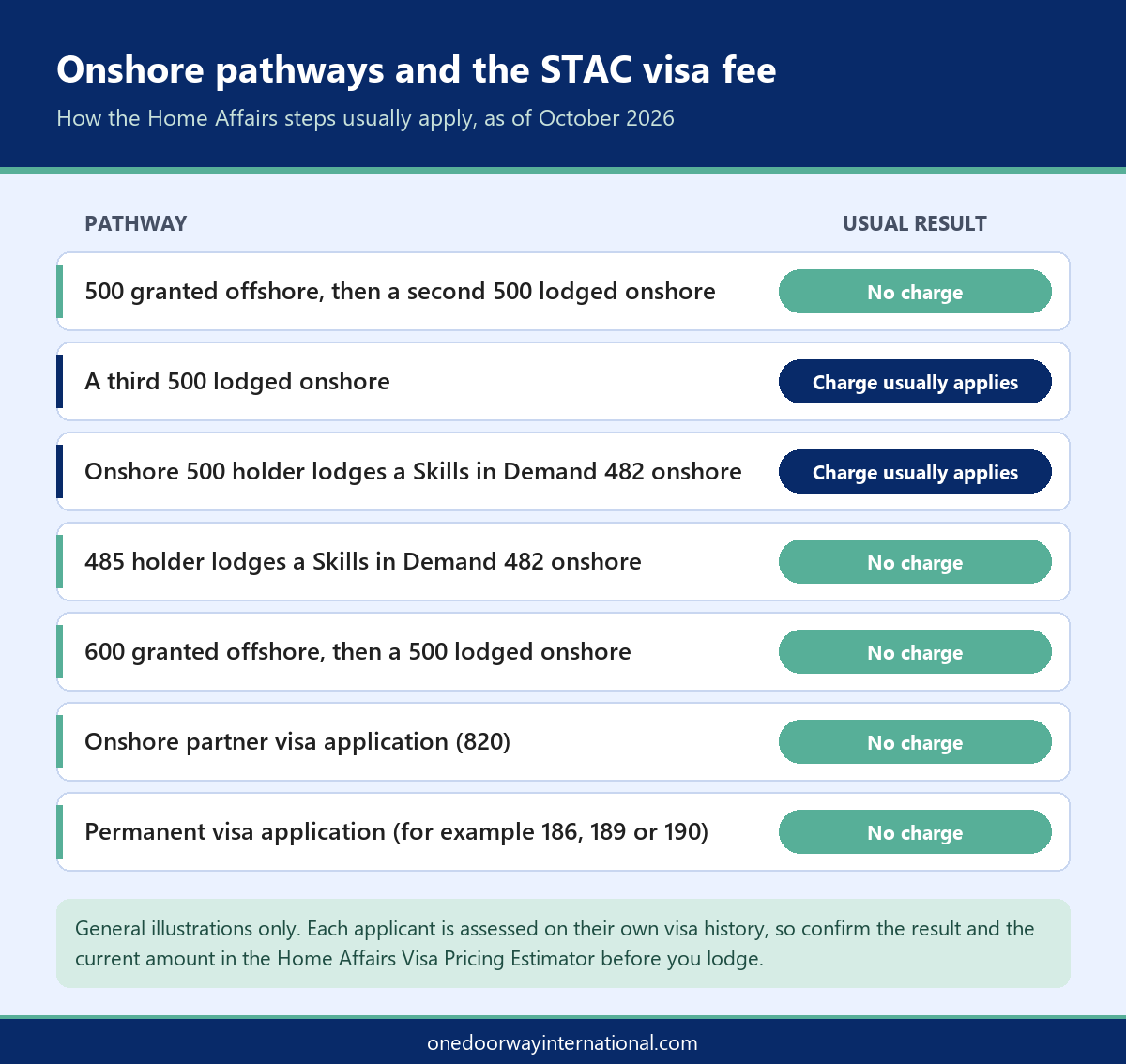
Here is how the Home Affairs steps apply to journeys we often see among clients in Narre Warren, Dandenong and Casey. These are general illustrations only, because your own visa history decides the answer. Each scenario assumes the person is in Australia when they lodge.
Student extending again
You arrived on a 500 granted offshore, then lodged a second 500 in Australia. That second application attracts no charge. A third 500 lodged onshore usually attracts the subsequent temporary application charge, because the visa you now hold was applied for in Australia.
Student moving to sponsored work
Your current 500 was lodged onshore and your employer now sponsors you for a Skills in Demand visa. Lodging from inside Australia generally triggers the subsequent temporary application charge. Your employer sponsored visa application still carries its own base charge as well.
Graduate on a 485
A 485 holder applying onshore for a Skills in Demand visa does not hold a Table 2 visa. On the official steps, the subsequent temporary application charge comes to zero. Moving through the 485 graduate visa route can therefore change your fee position.
Visitor becoming a student
Someone granted a 600 offshore who then lodges a 500 onshore pays no charge. If they had first extended their visitor visa onshore, the later student application would attract it.
Partner applicants
The 820 partner visa is not on Table 1, so an onshore partner application does not attract the subsequent temporary application charge. Dependants added to a further student visa are assessed one by one.
Fitting the Charge Into Your Australia PR Cost Budget
Most onshore applicants pay several temporary visa charges before they reach permanent residency. Each of those steps adds to your Australia PR cost. The subsequent temporary application charge can also appear more than once for each person in your household.
When you budget, list every temporary visa you expect to lodge. Mark which ones sit on Table 1, then check whether each applicant held an onshore Table 2 visa at the time. A couple on student visas with a child may face three separate assessments.
A simple worksheet helps. Write down each planned visa, the applicants on it, and whether the STAC visa fee is likely for each person. Then add the base visa application charge Australia lists for that subclass and any family member charges. Review the sheet whenever your plans change, such as a new course, a new sponsor or a partner joining your application.
We have not quoted a dollar figure in this guide. Charges change on a regular cycle, and the official worked examples are general illustrations. Use the Home Affairs Visa Pricing Estimator to see the visa application charge Australia applies to your subclass, including any STAC visa fee line, on the day you lodge.
For skills assessments, English tests, health checks and the PR visa charge itself, see our full PR timeline and cost breakdown. That guide is written for applicants outside Australia, so add the onshore extras from this article to your Australia PR cost plan.
Conclusion
The subsequent temporary application charge is easy to miss but simple to plan for once you know the rules. It applies per person, only to certain temporary visas lodged in Australia, and only after an earlier onshore temporary application. Graduates on a 485 and partner applicants often avoid it, while repeat student and visitor applicants usually do not. Map your visa history and your Australia PR cost before your next lodgement so the payment screen holds no surprises. To check your pathway and costs with a registered migration agent, book a consultation with our Narre Warren team.