

Choosing an Australia skilled visa often starts with one question: is my occupation in shortage? Jobs and Skills Australia answers part of that question each year. Its 2026 list, released in October, rates 279 of 1,021 occupations as in national shortage. For nurses, teachers, engineers and tradespeople already living in Melbourne, that rating shows how much demand there is for their skills. It does not decide which visa they can apply for. This guide shows where key occupations sit as of November 2026, what changed from 2025, and how to read a rating before you plan your next step.
Key Takeaways
- The 2026 Australia skills shortage list rates 27% of assessed occupations in national shortage, down from 29% in 2025.
- Most registered nurse specialisations, secondary teachers, civil, mechanical and electronics engineers, electricians, carpenters and plumbers are in shortage. Primary school teachers moved out of shortage this year.
- A shortage rating does not make you eligible for an Australia skilled visa. The visa occupation lists and a positive skill assessment Australia recognises do that.
- Australia PR still depends on the visa you choose, your points or sponsor, and an invitation or nomination.
What the 2026 Australia Skills Shortage List Shows
Each year, Jobs and Skills Australia (JSA) rates occupations for labour market shortage. You can search its 2026 occupation ratings by name or code. The list is a snapshot of the labour market at one point in time.
The 2026 assessment covers 1,021 occupations. Of these, 279 are rated in national shortage, or 27%. That is down from 29% in 2025 and a peak of 36% in 2023. A core group of 127 occupations has been in shortage every year from 2021 to 2026.
Each occupation gets one of four ratings:
- S: in shortage nationally.
- NS: no shortage.
- R: in shortage in regional areas only.
- M: in shortage in metropolitan areas only.
The skills shortage Australia reports is easing overall, but it is not spread evenly. JSA found that almost half of technicians and trades workers and 37% of professionals were rated in shortage. Long running gaps sit in construction, engineering, electrotechnology, health and early childhood education. This is why the Australia occupation shortage list matters most to the people we speak with in Narre Warren, Dandenong and Berwick.
JSA also looks at why shortages happen. Its 2026 analysis names three main drivers: limits in the training pipeline, a lack of suitable applicants, and trouble keeping workers. For registered nurses, suitability was the main driver, with training also a major factor. In plain terms, employers want nurses, but they need applicants whose qualifications and experience meet Australian standards. That is why a recognised skill assessment Australia accepts is so central to any plan, even in a shortage occupation.
Shortage Occupations by Field: Nurses, Teachers, Engineers and Trades
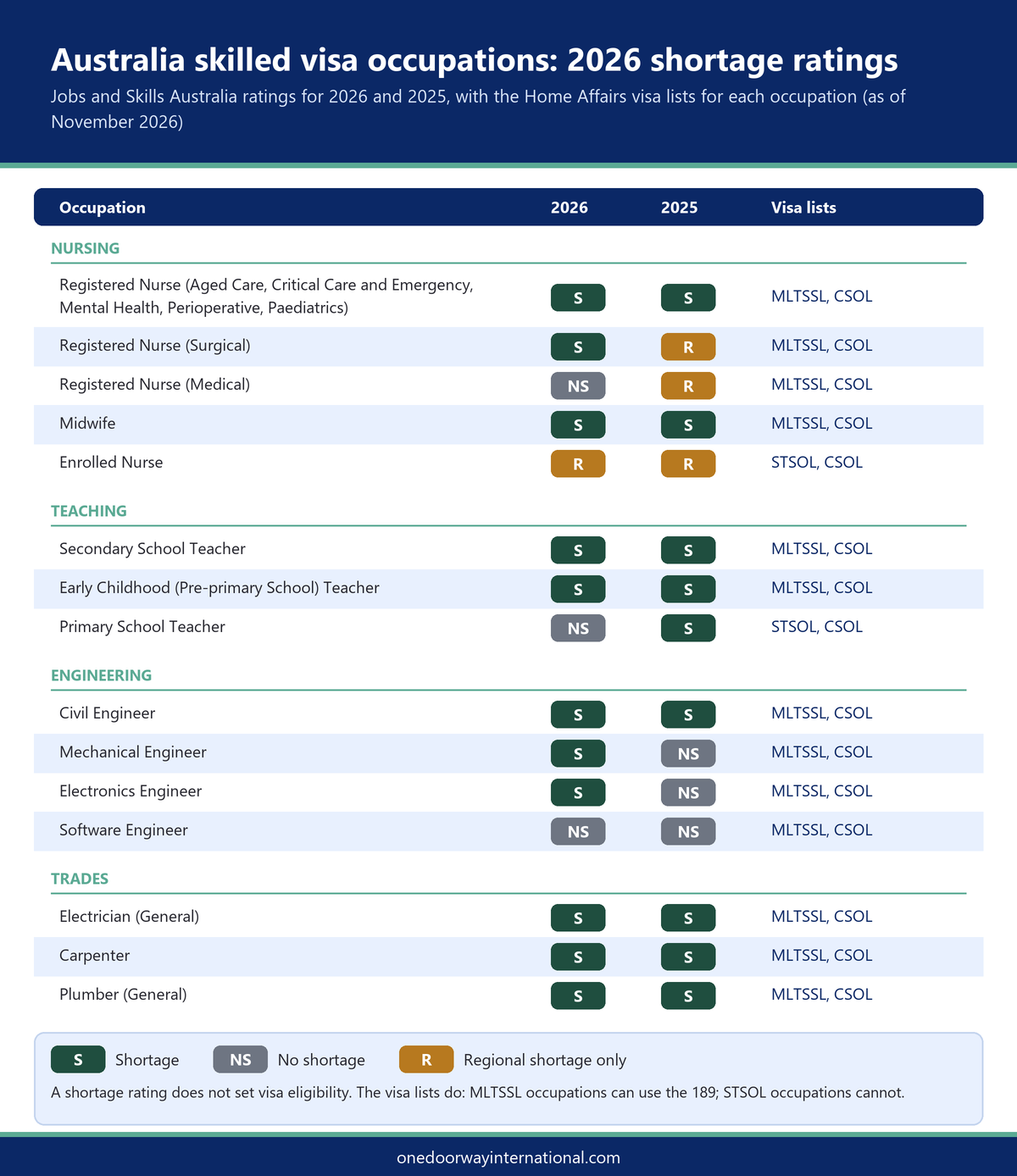
The ratings below were read from the JSA data on 6 November 2026. Occupation names follow ANZSCO, the classification Home Affairs uses for skilled visas.
Registered and enrolled nurses
Nursing remains one of the clearest shortage areas. These registered nurse specialisations are in shortage in 2026 and were also in shortage in 2025: Aged Care, Child and Family Health, Critical Care and Emergency, Disability and Rehabilitation, Mental Health, Perioperative and Paediatrics. Midwife and Nurse Practitioner are in shortage too.
Some nursing ratings moved. Registered Nurse (Surgical) went from regional shortage to national shortage. Registered Nurse (Medical) went from regional shortage to no shortage. Community Health and Developmental Disability moved out of shortage.
Enrolled Nurse is rated as a regional shortage only, as it was in 2025. It also sits on the Short-term Skilled Occupation List rather than the medium and long term list. That means the 189 is not open to enrolled nurses, while state nomination and employer routes can be.
School and early childhood teachers
Secondary School Teacher, Middle School Teacher, Special Needs Teacher and Early Childhood (Pre-primary School) Teacher are all in shortage in 2026.
Primary School Teacher is the notable change. It was in shortage in 2025 and is rated no shortage in 2026. Some websites say primary teachers are newly in shortage, but the JSA data shows the opposite. Primary teaching is still on the visa lists. It sits on the Short-term Skilled Occupation List and the Core Skills Occupation List, so it suits state nomination or employer sponsorship rather than the 189.
Engineers
Civil, Structural and Electrical Engineers stay in shortage. Mechanical Engineer and Electronics Engineer are newly in shortage in 2026, after no shortage ratings in 2025. Chemical, Industrial and Software Engineers are rated no shortage.
Software Engineer is a useful reminder of how the system works. It is not in shortage, yet it remains on the Medium and Long-term Strategic Skills List and can still be used for the 189.
Construction and electrical trades
Trades carry the strongest shortage signal. Electrician (General), Carpenter, Carpenter and Joiner and Plumber (General) are all in shortage in 2026, as they were in 2025. Gasfitter, Drainer, Roof Plumber and Airconditioning and Mechanical Services Plumber are in shortage as well. Electrician (Special Class) moved out of shortage this year.
Why a Shortage Rating Is Not an Australia Skilled Visa List
This is the point many pages skip. The shortage list measures the labour market. It does not set visa eligibility. Home Affairs uses separate occupation lists, made by legislative instrument, to decide which occupations each visa accepts. You can look up any occupation in the Home Affairs occupation search.
The lists work like this:
- Core Skills Occupation List (CSOL): used for the Skills in Demand (subclass 482) Core Skills stream and the Employer Nomination Scheme (subclass 186) Direct Entry stream.
- Medium and Long-term Strategic Skills List (MLTSSL): the list for the 189 and the widest range of skilled visas.
- Short-term Skilled Occupation List (STSOL) and Regional Occupation List (ROL): narrower lists, mostly used for state nominated, regional and employer visas.
The two kinds of list are easy to mix up, because many websites call all of them "the shortage list". When you read that an occupation is "on the list", ask which list. A rating on the Australia occupation shortage list tells you about demand. A place on the MLTSSL, STSOL, ROL or CSOL tells you which Australia skilled visa can use that occupation.
Two examples show the gap. Software Engineer has no shortage rating, yet it is on the MLTSSL and the CSOL. Primary School Teacher lost its shortage rating, yet it stays on the STSOL and the CSOL. In both cases the visa options did not change with the rating.
So why does the rating matter at all? Shortage evidence is one of the inputs used when occupation lists are reviewed. A long run of shortage ratings supports an occupation's place on a list. A long run without one can put it at risk at a later review. Home Affairs also states that pending nominations and visa applications are not adversely affected if an occupation is later removed.
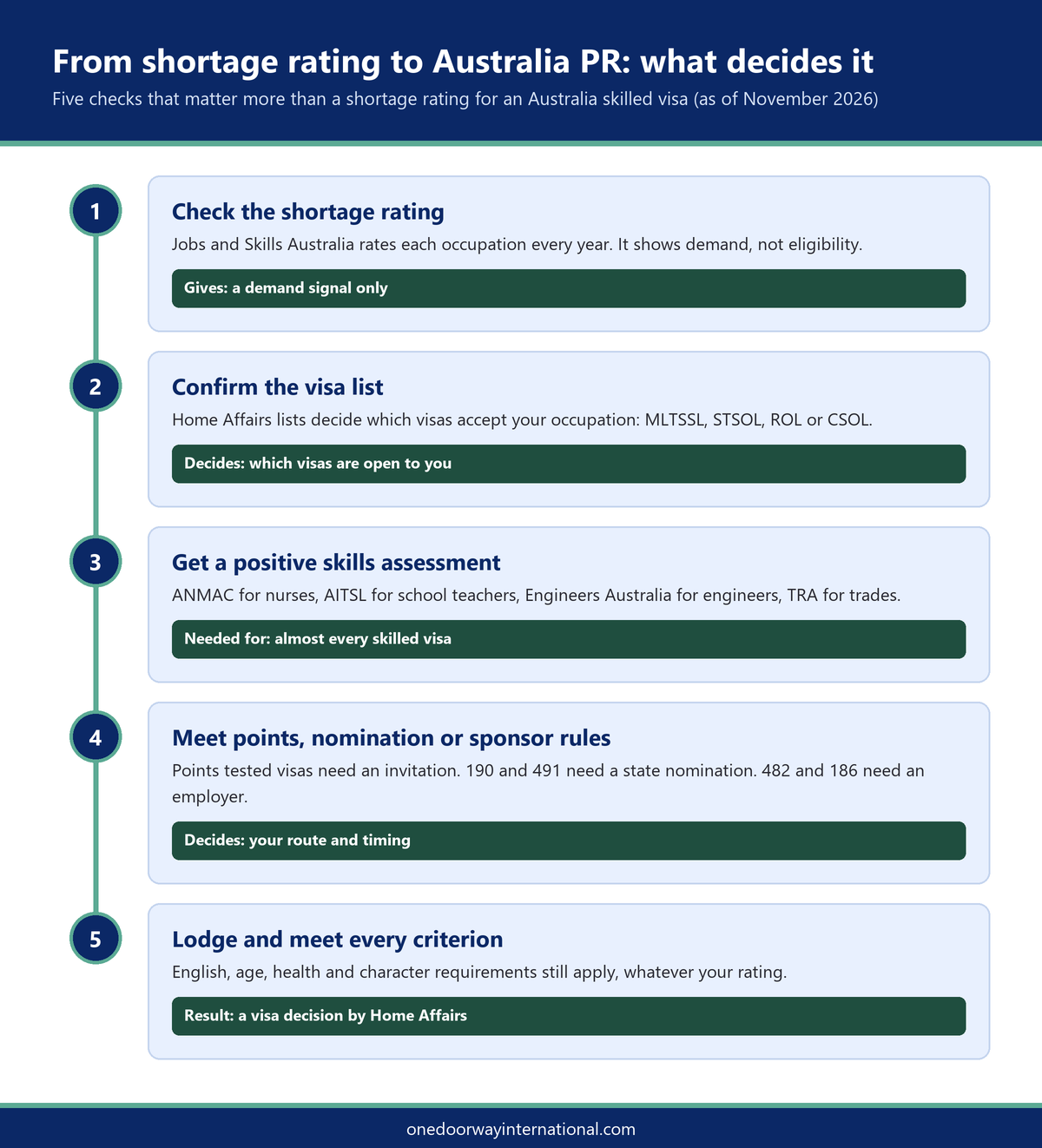
An Australia skilled visa still needs every criterion met. That means an eligible occupation on the right list, a positive skills assessment, the required English level, age requirements and, for points tested visas, enough points and an invitation.
Turning a Shortage Occupation Into Australia PR
A shortage rating can still help in practice. Employers struggle to fill these roles, so they may be more willing to sponsor. States and territories may also look at shortage evidence when they choose occupations for nomination. Even so, a rating gives no extra points and no guaranteed invitation for an Australia skilled visa.
Start with the right skills assessment
Every skilled route starts with a skill assessment Australia recognises for your occupation. The assessing authority depends on your role:
- ANMAC: registered nurses, enrolled nurses and midwives.
- AITSL: primary, middle and secondary school teachers.
- ACECQA: early childhood teachers.
- Engineers Australia: professional engineers.
- Trades Recognition Australia (TRA): electricians, carpenters and plumbers.
Our guide on which authority assesses your occupation explains each one. The occupation on your assessment must match the occupation you nominate for your visa.
Match your occupation to a visa
Next, match your occupation and its list to a visa:
- 189 Skilled Independent: MLTSSL occupations, points tested, no sponsor.
- 190 Skilled Nominated and 491 Skilled Work Regional: state or territory nomination, open to more lists.
- 482 Skills in Demand: employer sponsored, with Specialist Skills, Core Skills and Labour Agreement streams. Home Affairs sets out each stream on its Skills in Demand visa page.
- 186 Employer Nomination Scheme: a permanent employer route.
You can compare the 189, 190 and 491 side by side, or read about permanent residency through an employer. If an employer wants to sponsor you, our employer sponsorship support covers the 482 and 186 steps.
Plan from your current visa
If you hold a 500, 485 or 482 visa now, timing matters as much as your occupation. A graduate on a 485 may need a skills assessment and English result well before the visa ends. A worker on a 482 may have an employer route to Australia PR through the 186, if the employer will nominate them. Check your options by current visa well before your visa end date. Shortage ratings can change every year, so treat this guide as a snapshot of the skills shortage Australia measured in 2026, and check the live data before you lodge.
Conclusion
The 2026 ratings confirm strong demand for nurses, secondary and early childhood teachers, many engineers and the core building trades. They also show primary teachers and some nursing specialisations moving out of shortage. Use the list as a signal, not a test. Your Australia skilled visa options depend on the visa occupation lists, your skills assessment and your points or sponsor. Those decide whether a path to Australia PR is open to you. If you want a clear plan for your occupation, talk to our GSM visa service team in Narre Warren. We will review your situation and explain your options.